On the Way Home

The Warrego River near Cunnumulla

Part 1: Surviving the Cold Nights in Outback NSW

My new, beloved sleeping bag is supposed to provide comfort down to -6 degrees and ensure survival to -13, but I start to feel slightly less than completely warm at zero to one degree, which seems to be a common overnight temperature in western NSW at this time of year.

This loss of perfect comfort, however, only becomes noticeable after I leave my feather-down refuge to visit the facilities at 5 in the morning and then return shivering to our tent. Those visits to the outside world are like Harry Potter plunging into the freezing pool to retrieve the sword of Godric Gryffindor, except that, unlike Harry, I’m not brave at all—I’m more of a Hufflepuff type.

The facilities and bush artefacts at Billy’o Bush Retreat
Preparing for the icy night in Wongarbon: The hot water bottle and woollen socks (in addition to my magical sleeping bag) kept me toasty warm all night long .

After the foully unappealing caravan park in Longreach, David had wisely booked campgrounds in regional NSW outside the major towns. Unfortunately, we experienced only two of his choices, Kidmans Camp in North Bourke and Billy’o Bush Retreat,15 kilometres out of Dubbo in Wongarbon. Both were welcoming, delightful places, ideal for my research into how to survive freezing temperatures in a tent. On our last night, I discovered that a hot water bottle, woollen tights, and the knitted socks made for me by my German-French friend, Moni, insulated me from the creeping cold of the early morning.

Sad to say, that was to be my last chance for night-time research…

Part 2: Our Last Frenetic Day
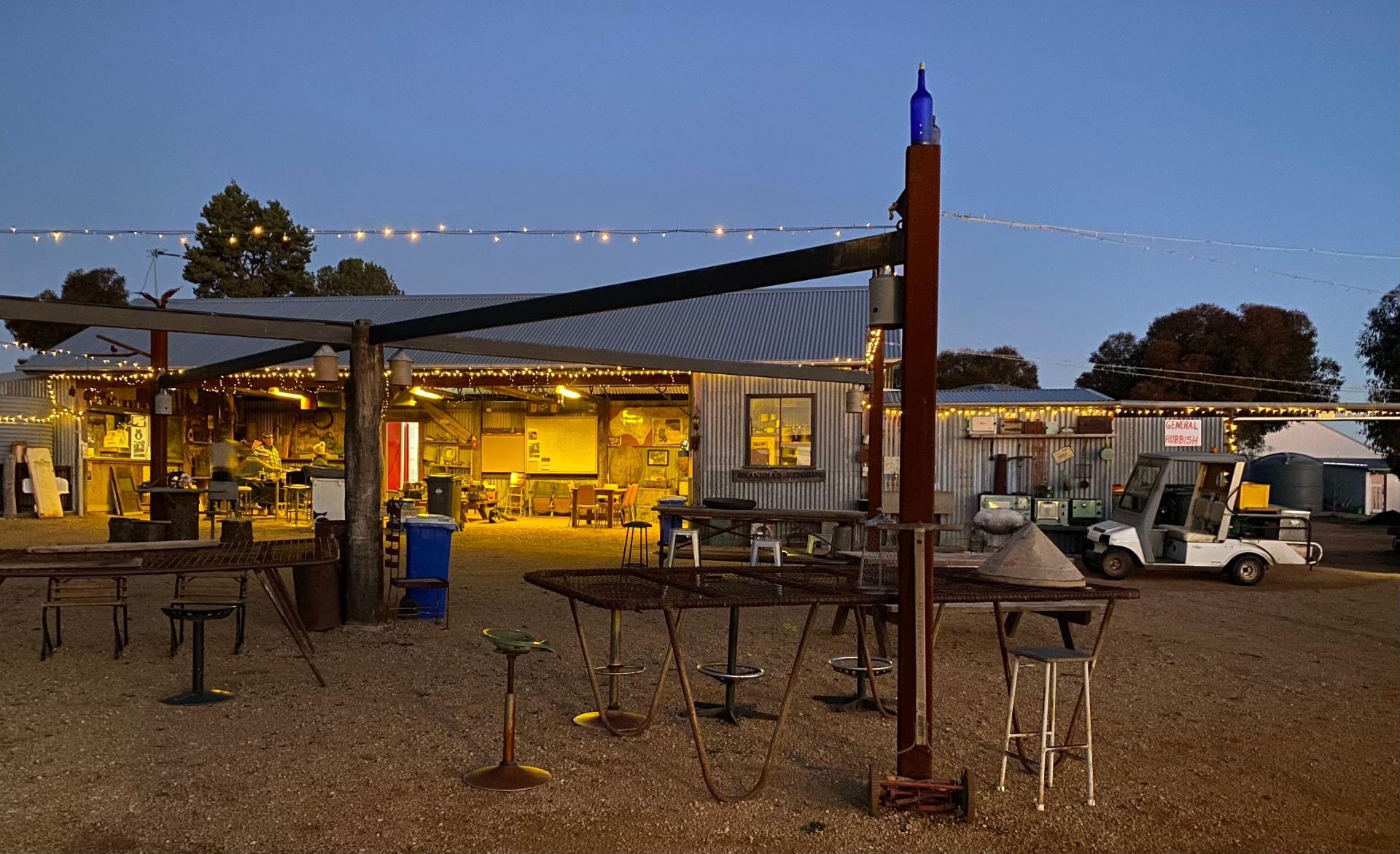
The bar and kitchen at Billy’o Bush Retreat near Dubbo, where the owner, Mark, wore a tee-shirt with the words “Go to Billy’o!”

David and I had kept an eye on the worsening COVID situation in Sydney and checked in frequently on the Victorian border pass website, but it was only on Sunday morning, 11 July, that the notifications on our phones, along with our friends’ text messages, became urgent enough to make us think that we had no choice but to head for home and give up our plans to visit Parkes and Jerilderie. 

David had booked us tickets for the Royal Flying Doctor Visitor Experience and the Western Plains Zoo in Dubbo. As we visited each one, we were on tenterhooks, checking our phones, watching parts of press conferences, and hoping that we could indeed indulge ourselves with this one last day.
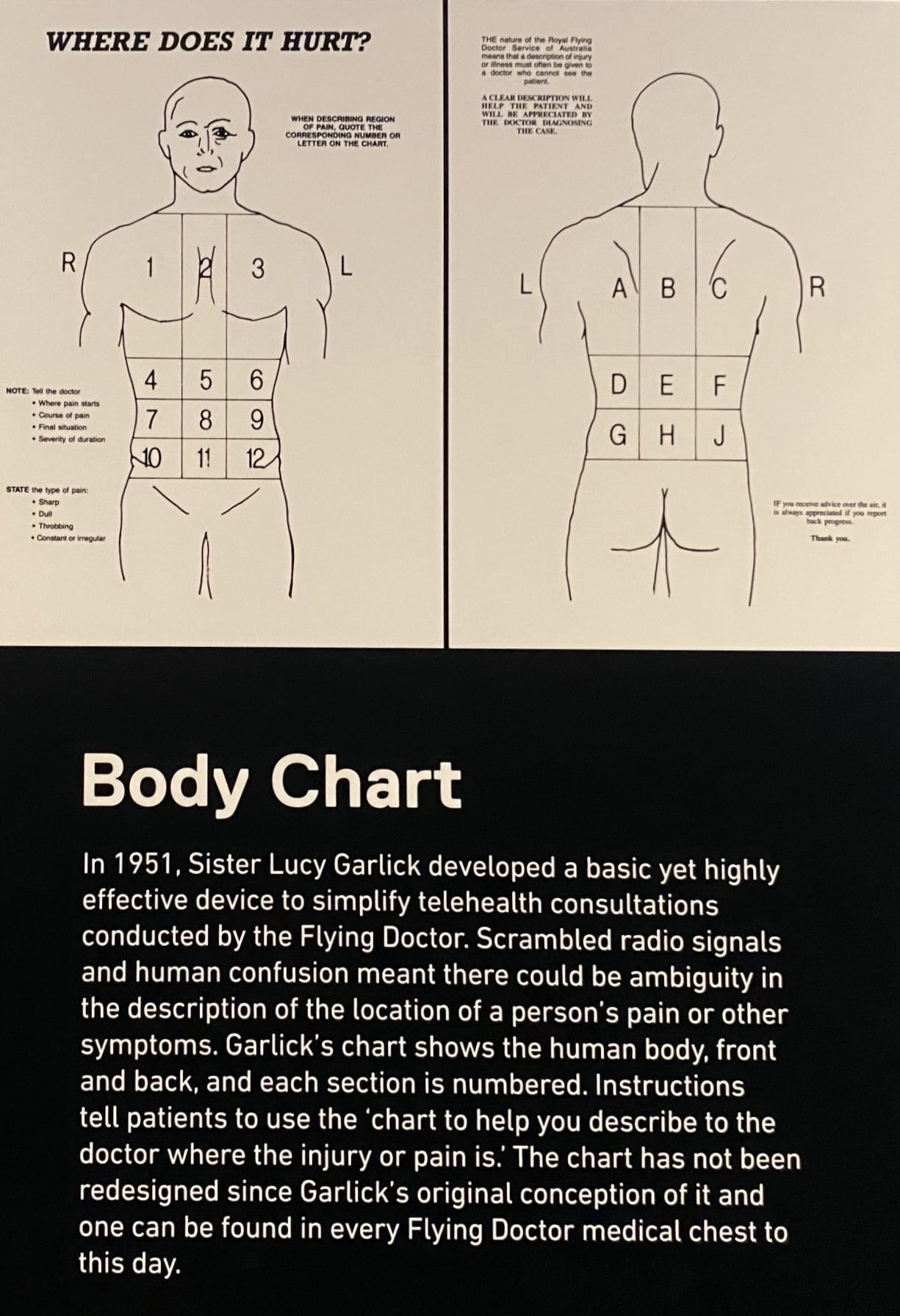
A simple, clever idea employed by the Royal Flying Doctor Service

The Flying Doctor exhibition was eye-catching and engaging, with an emphasis on the history of the service, the extensive areas now covered, and the simple, clever ideas that have been developed to improve the lives and care of people in remote areas. There were many personal stories, both inspiring and distressing. Some bush people describe gruesome injuries with self-deprecating humour and airy nonchalance. One man had lost his lower leg in a farm machinery accident and had only survived through the work of the Royal Flying Doctor Service. He said wryly that he could just about have Frequent Flyer rights. 
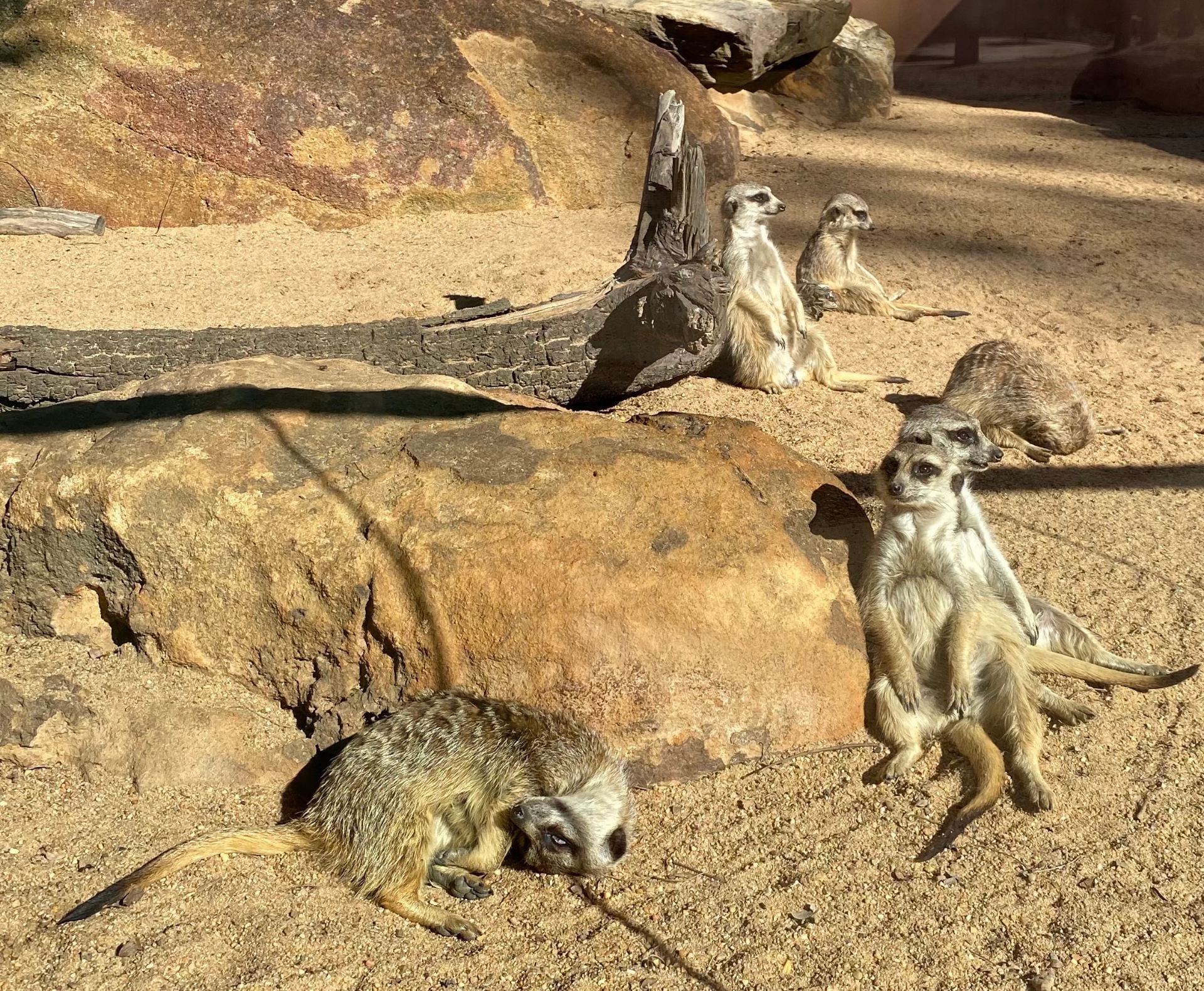
If only I could emulate the relaxed attitude and stance of the meerkat on the left!

Time was slipping away by the time we reached the Western Plains Zoo. We had been vacillating all day between leaving for Victoria immediately or staying one more night at Billy’o. Viewing the animals and reading about their characteristics served as a soothing distraction. The meerkats looked as though no political or bureaucratic decision would ever faze them. The details about the mating behaviours of cheetahs and Galapagos tortoises also allayed my anxieties briefly. The male tortoise has such poor eyesight that he has been known to try to mate with a stone, if it only resembles a female closely enough. If this hadn’t been written by a zoologist, I never would have believed it.

On the way home to Billy’o we decided that we might as well pack up our tent and leave for Victoria straightaway rather than wait until the following morning. Just as we finished packing, a notification came through that the border was to be closed at midnight.

It was a beautiful sunset as we were driving to the border, but I wouldn’t let Davey stop…

That 6-hour drive through the darkness, the roadworks, the fog and the stillness of the outback was like a forced march. We had about an hour up our sleeves, but I kept imagining the worst, as I typically do. David was sunny and optimistic, while I pictured smashed windscreens, punctured tyres and unexpected collisions.

When we reached the border at Tocumwal at last, it was utterly deserted and eerily quiet. We had expected a checkpoint with masked police, flashing lights, QR-readers and bottles of sanitiser. There wasn’t even a witch’s hat.

Well, really. After all that.

Davey’s brand new slippers from Jassi Leatherworks

Luckily, Victoria is quite small compared to the rest of Australia. We had only about three hours left to drive home, and when we arrived David’s new slippers, ordered from Jassi Leatherworks near Denmark in Western Australia, were waiting in the dark kitchen to receive us. They would have come in handy in outback NSW.

Final Notes:

Total Kilometres: 19,259

Accommodation:

Our trip around Australia (map created through David’s WikiCamps app)

Part 3: Campground Inhabitants

The Five Most Likeable Campground Inhabitants

1 The man who stopped us just in time from driving off while our fridge was still plugged in (this happened more than once);
2 The older woman in a velour dressing gown who didn’t mention a single travelling experience and admitted that she spent a lot of time reading;
3 The other cooks who admired our collapsible cookware, the only equipment we possess that ever elicited positive remarks;
4 The person who warned us that we would need a G2G pass for Western Australia, even when there was not a single COVID case in the whole country;
5 The quiet couple in a modest camper van who turned up unexpectedly at the same campsites and greeted us on each occasion rapturously and by name.

The Five Most Annoying Campground Inhabitants
1 The woman who face-timed with several friends and family members in the camp kitchen—or in any other crowded or highly audible location (this happened more than once);

“Oh darling, the cruise was lovely but the food was a disappointment. And the wine too. For $350 I expected better.”

2 The man who spoke loudly, piercingly and incessantly about his successful adventures and travel experiences; 

3 The woman who told us where we should have gone on our trip and who sighed deeply when we told her that we had missed that magical location she had just mentioned, now 1000 kilometres away;

“What, you didn’t go there? Oh, but you don’t know what you missed! You really should have!”

4 The child whose shrill screams cruelly penetrated our consciousness and who then switched to ear-splitting weeping when not sufficiently indulged by his or her hapless parents;

5 The couple who regaled us with stories about the outstanding qualities of their rig, 4WD and general equipment.

“And then we thought, why not just spend the $90,000? Our kids don’t need it and we deserve some luxury.”

From Longreach’s Dreamers to Charleville’s Starry Nights

David (looking rather thin from all our camping exertions) at the Qantas Hangar at Longreach

Where not to camp: Longreach Tourist Park was all gravel and slush

We were out of Longreach Tourist Park by 8.30 in the morning and I was glad, for it was the most featureless, least prepossessing campground that we had ever encountered. There was no grass, only gravel, and the rigs were packed as tightly as fat lambs in a dusty yard being drafted for market.

To make matters worse, some caravan owners released their grey water directly onto the unmade tracks between each packed block of caravans, thereby creating puddles in which children paddled. Eww.

Some bright spark in the landscaping department had decided to make several decorative fake rocks to scatter around, rather than plant trees. That sums up the type of place it was.

We had been drawn to Longreach by the Qantas Founders Museum just outside the town, which I enjoyed more because of the human stories than the aviation details. All the same, I tried very hard to pay attention during our tour of the hangar, led by a passionate young man called Jonathan, who had been involved in working bees there from the age of 4. His knowledge of 747s, one of the planes we toured, was encyclopaedic. He explained how the lavatory hatch worked and I was relieved to discover that the waste products were piped out and disposed of responsibly (unlike the grey water at Longreach Tourist Park, sorry for harping). Getting within three metres of a running motor, Jonathan informed us, would be dangerous, since you could be sucked into the works.

The first ever Qantas plane

One of the children asked: “You mean you will never come out?”

Jonathan replied: ““I mean, you’ll come out. You’ll just be in lots of little bits.”

This reminded me of my former life as a teacher, when answering fundamentally unanswerable questions could lead to cheery absurdities and farcical exchanges.

From Jonathan I learned that a 747’s maximum weight for taking off was heavier than for landing; that a 747 flew 19,000 cycles (taking off, flying somewhere and landing) before being retired; and that a single new tyre cost $3000.

My favourite piece of aviation trivia was the story of the Captain Cook Lounge, an early luxurious bar provided upstairs near the cockpit for first-class passengers to sit, drink and feel important in, until someone realised that this was no way to make money. It is somehow both ironic and satisfying to learn that this ultimate proof of our anything but classless society should have been scrapped to fulfil capitalistic ambitions.

The Captain Cook Lounge

The founders of Qantas seemed to be surprisingly humble men who perceived a future in aviation even while others doubted their vision. They wanted to overcome the tyranny of distance, an aim that I can just dimly appreciate after travelling in relatively comfortable circumstances around this vast land. One wag in Longreach evidently quipped in the early years that the original Qantas hangar would be more useful as a shearing shed. Yet the founders persisted.

Bush choreography at the Charleville Bush Caravan Park

The isolation of the outback was a motivating force in the founders’ dream. The part of the museum that I liked most was the oral histories about the lonely lives of women in the outback. One woman treated her burns with mutton fat and kerosene. Another raised two young boys on her own in the bush while her husband was mostly away working, but when her infant daughter died, she could bear it no longer. I would have escaped long before she did.

Creative cogs at the Charleville Bush Caravan Park

After we set up our tent in the Charleville Bush Caravan Park (not one puddle of grey water), we shot off to the Cosmos Centre to look at the stars with the help of Cam, a guide who reminded me of the professor in “Back to the Future”. He was just as loveably geeky as the fossil scientists of Riversleigh and he was as familiar with the night sky as I am with my best-loved knitting patterns.

With the help of a 30-inch reflector telescope mounted in our little real-life planetarium, we looked at the sky through Cam’s eyes and saw, as Banjo Paterson described it, “the wondrous glory of the everlasting stars”*. Among other distant phenomena, I looked at one of the stars of the Southern Cross beside a smaller red dwarf that would not normally be visible to the naked eye. The first star was bright and brilliant, the second slowly burning out its dying energy.

Our tent in the garden at Winton Wanderers Caravan Park

I am becoming weary of travel, while David is as eager and energetic as ever. Whereas I just want to get through the “orange zone” of NSW, have a COVID test and then isolate myself in our heated lounge room, he is still busily googling, booking activities and planning our life in the cosmos. I am swept along by his enthusiasm. In our shambolic team, Davey is the bright and sparkling star in the Southern Cross, while I am gradually losing my powers like that fading red dwarf.

* From “Clancy of the Overflow”

Final Notes

Accommodation:

The cooler days are speeding up my knitting projects.

If Only:
As we drove through the little town of Ilfracombe, only 25 kilometres further along the Landsborough highway from Longreach, we saw a grassy, homely little campground (see the picture at this link) near a welcoming pub. If only we had stayed there instead of in the crowded, soulless paddock at Longreach, we thought.

Corrugated iron wall painting in Augathella
Deb’s instant mash and David’s beef stroganoff at Winton Wanderers

Mt Isa and the Fossils of Riversleigh

An artist‘s representation of a short-nosed kangaroo: By falling into this cave, the poor creature had escaped from the marsupial lion (see picture below) but was fated to die and become a fossil.

♦  —  ♦  —  ♦  —  ♦  —  ♦

“What exactly is ‘guano’?” I asked.

“Shit,” David replied.

He has such a poetic turn of phrase.

The many species that have been identified through the work at Riversleigh

We were reading a placard in the Fossil Discovery Centre in Mt Isa about the work of palaeontologists at Riversleigh, about 250 kilometres to the northeast. Our original plan had been to do a mine tour in Mt Isa, but in the past week outback Queensland had become a crowded conduit for the displaced travellers in the far north of Australia. The mine tours were booked out for days on end.

Shallow as I am, I feel much the same way about mines as I do about dams, so I didn’t really care, but I was disappointed for David’s sake.

The scary “killer kangaroo”, which evidently galloped rather than hopped

The Fossil Discovery Centre was our alternative tourist activity and I was discovering that it was by no means a second-rate consolation prize. Like all the best museums and exhibitions, it was carefully conceived, meticulously presented and genuinely captivating.

If there is one thing that reassures me that life has a purpose and that it is worth continuing to strive and exist, it is the loveable geekiness of scientists. They take up some obscure branch of knowledge that may never touch the lives of ordinary people and then pursue it with the kind of passion that convinces me, almost beyond doubt, that human nature has more than a grain of goodness and decency in it.

In fact, such scientists demonstrate that we live not just to produce excrement but also to perceive, to dream and to comprehend all mysteries.

I am grateful not to encounter these giant birds as I visit the facilities on a dark night in the Outback.

This brings me back, however circuitously, to the guano question. Guano refers in this case to bat waste. Layers of bat excrement, along with the lime-rich rock in the Riversleigh area, had helped preserve the bones, jaws and skulls of frogs, birds and marsupials, along with the soft tissues of insects, snails and plants—almost from the moment that these living things died. The conditions at this particular site were simply ideal for the formation of fossils.

As a result of its dense fossil formations, Riversleigh has been recognised as a world heritage site and has lured palaeontologists from all over the world. These scientists can draw conclusions from the perfectly formed fossils in this region about the last thirty million years of animal evolution in Australia.

Who would ever have thought that bat excrement could contribute so significantly to human knowledge?

The marsupial lion: In the cave diorama, he was shown staring down at the short-nosed kangaroo, which had fallen out of his reach (but into the claws of future scientists).

The exhibition was a creative masterpiece, with many eye-catching representations of long-extinct relatives of modern animals: the short-nosed kangaroo, the killer kangaroo, a koala that was half the size of the modern version but with a broader diet, the diprotodon (a giant wombat-like marsupial) and so on. Then there were the extinct animals with no modern relative, such as the marsupial lion and the giant birds, known in the vernacular as the “demon ducks of doom”. Finally, some fossils were too insubstantial for confident extrapolation of their characteristics. One was given the provisional name of “thingodonta”.

David and I wandered happily through the superb dioramas, one in the form of a cave, one a forest filled with prehistoric animals with placards to help us identify each one. There was even a little waterfall.

I wanted to say to David: “Isn’t this far better than a mine?”

But I didn’t want to seem heartless, so I asked him if I could take a photo of him emerging from the cave. My dear old fossil. It was the closest we were going to get to an underground experience. And best of all, there was no guano to be seen.

Human emerging from cave: At first glance, it may seem like a primitive creature, but in reality it is a complex mixture of sophisticated camping behaviours and bike-loving emotions. In the primeval struggle for survival, it is impaired by its lack of protective head hair, but the long proboscis, by providing it with crucial environmental information, especially about the wine it ingests, strengthens its capacity to sustain and enrich its existence.

Final Notes

Accommodation
Discovery Park – Mt Isa (We had our own ensuite. It was pricy but heavenly.)

Podcasts for Our Long, Lonely Drives 
(especially the one from the Northern Territory into Queensland) 
The diprotodon, often described as a kind of giant wombat
A scene from the forest diorama, showing that 30 million years ago this part of Queensland was covered by lush forests, a rich diversity of fauna and even waterfalls!
Mt Isa’s mine chimneys in the evening light

Back to Katherine—and Phone Notifications

Davey cooking up chicken curry for our dinner in Katherine

Part 1: Traveller Torture

When we arrived in Katherine after two nights in Kakadu, all the Woolworths assistants were wearing masks, a large crowd was shopping at 3 o’clock on Sunday afternoon, and the  bread had completely sold out. We had been mostly without coverage in Kakadu and our phones now flashed us notifications that explained people’s strange behaviour. Darwin had gone into lockdown two hours before our arrival in Katherine, and the premier of South Australia, in a fit of premature panic, had sealed his state from all aliens, or rather, other Australians. The West Australian Premier had sealed his border too.

I am not against carefully restricting the movements of people who have been in a hotspot, but locking everyone out of half of Australia because of one case in a remote mine? If only Australian governments could be more measured in their reactions, more rational in weighing up all the risks involved, more systematic in buying a range of vaccines, and more competent in rolling them out. 

“We have nowhere to go,” was a common refrain in the Katherine Holiday Park. I felt for our fellow travellers. Some had booked and paid for accommodation, flights and cruises in the Kimberley; they discovered now that their mere presence in the Northern Territory—not even in a hotspot—would oblige them to quarantine for 14 days at their own expense if they crossed into Western Australia.

We realised that we had achieved the partner look quite unintentionally.

“We could just drive around in circles,” I said to Davey.

“There are no circles in the Northern Territory,” he replied. “There are just roads that take you from north to south or east to west.”

He spends too much time looking at maps, but it can be useful.

For once our lack of planning proved to be a blessing. We had tried to book a site in Alice Springs* but it was lucky that we had failed, since South Australia was no longer a possible way home. The north to south road was out.

So we filled in our Queensland Travel Declaration, downloaded it while we still had mobile coverage, and headed south towards Three Ways to take the road east.

* A Queenslander at Camooweal commented that he expected Alice Springs to go into lockdown, since the mine workers flew in and out of that airport. His words were prescient: the very next day, June 30, Alice Springs also went into a precautionary lockdown. 

Part 2: Kakadu

Pink sunset on Yellow Waters

We found Kakadu quite difficult to navigate, perhaps not surprisingly, given its size. Whereas there were simple online fact sheets for both Keep and Litchfield, which provided precise details about all the best short walks in one straightforward file, Kakadu’s documentation was fragmentary and confusing. There were PDFs about some walks, yet without information about the walk’s location in the park and how to get to the starting point. It seemed as though there was no clear overarching plan aimed at making the features of the park as easily accessible as possible.

It looked as though much of the park infrastructure had been set up in the 1980s and then allowed to disintegrate slowly and inexorably. The signage on some of the walks and the tracks themselves clearly needed upgrading, especially when compared to the beautifully maintained signage and tracks at Litchfield.

Kakadu is administered by the federal government, and it shows.

An ancient painting at Ubirr

Yet there is so much that is not to be missed at Kakadu, such as the rock art sites at Ubirr and Burrungkuy (Nourlangie). At Ubirr we had the feeling, as we had at Nigli Gap in Keep, that we were encountering a world from days long gone, a place where people had lived vibrant, mysterious and unimaginable lives far removed from ours.

Ancient rock art at Burrungkuy
A lily contrasts with the lush green of the grass.

Mandy Muir of the Murrumbur clan was our tour guide during our cruise on Yellow Waters. She is an Indigenous woman who has family connections in both  Kakadu and the Kimberley and who has worked on the wetlands for over 30 years. It was an utter delight to be in her company. She told us of her youth in this magical “backyard” and revealed the depth of her knowledge at every twist and turn of her amazingly manoeuvrable boat.

Mandy could name every kind of bird on the waters, tell us where and how old their nests were, identify the trees where their young were about to spread their wings, and point out hidden inlets where crocodiles were hunting barramundi in plain sight. At one point, as a crocodile was closing in on its prey, the barramundi in danger from those mighty jaws leapt over the scaly body and fled into open water. It seemed that our tour guide knew exactly where to take us so that we could watch the wetland creatures and appreciate their idiosyncrasies.

A paradise for birds

As we drove through the waters teeming with bird life, Mandy drew in close to the banks so that we could snap shots of the fat crocodiles lying along the muddy edges. She also provided insights into the difficulties of administering the park and touched on the problems caused by feral animals such as buffaloes. Her warmth, humour and generosity were as memorable as the wetlands themselves.

A crocodile on the bank of Yellow Waters – we saw many of them sunning themselves and making no attempt at camouflage.

Final Notes and Comments
Accommodation

A List of the Birds We Saw on Yellow Waters: 

Jabirus, egrets, brolgas, snake-necked darters, brolgas, spoonbills, magpie geese, plumed whistling ducks, white-bellied sea eagles… There were others but I didn’t catch all their names!

A Pertinent Quotation from the Ever-Quotable Katherine Murphy:

The default in Australia throughout this pandemic has been risk aversion. (The Guardian, 30-6-2021) 

Sun over Yellow Waters
Another view over the wetlands
A snake-necked darter looks over its territory.
A view over Banka Banka Station, our last overnight stop during our hasty exit from the Northern Territory