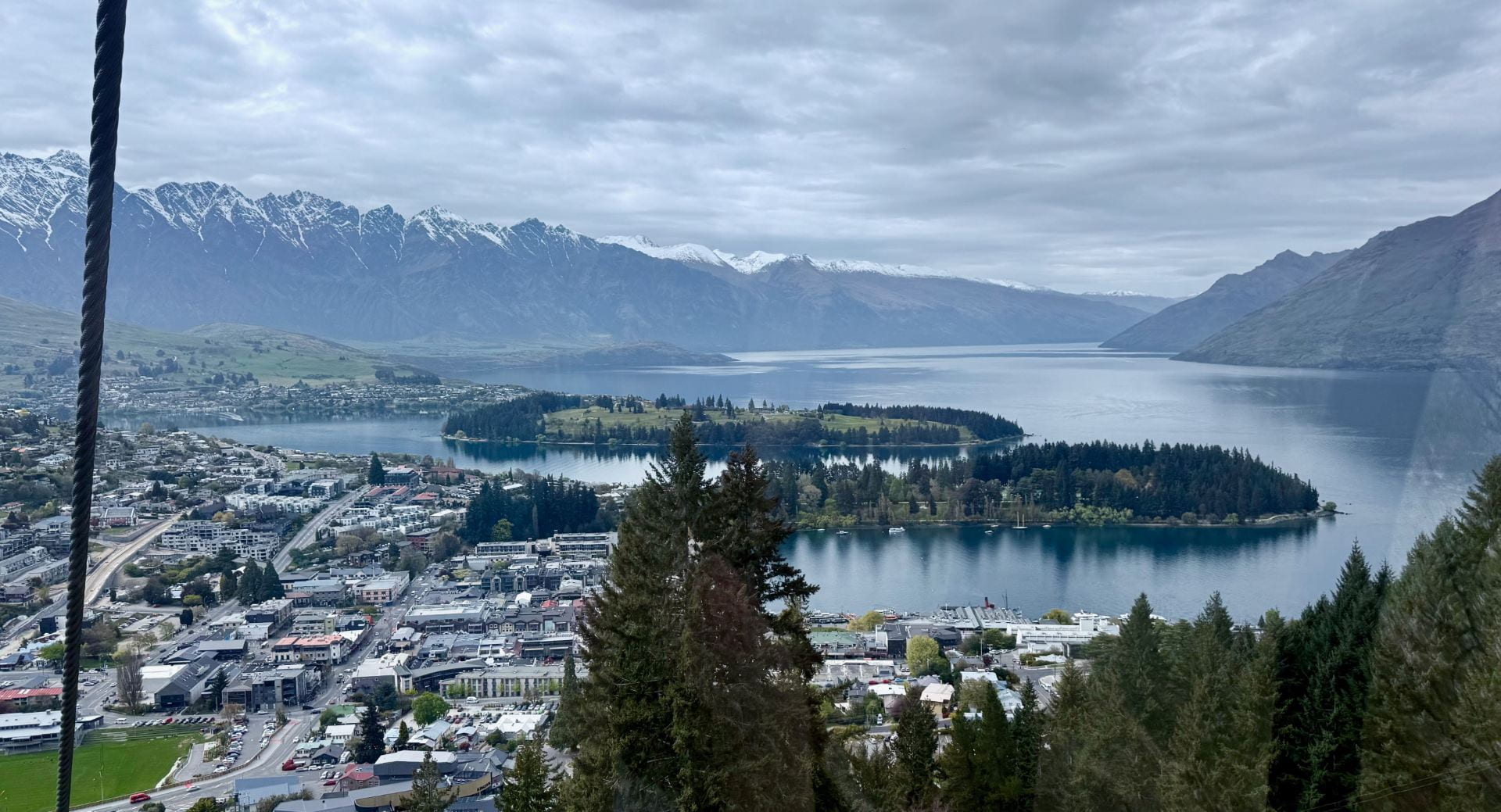
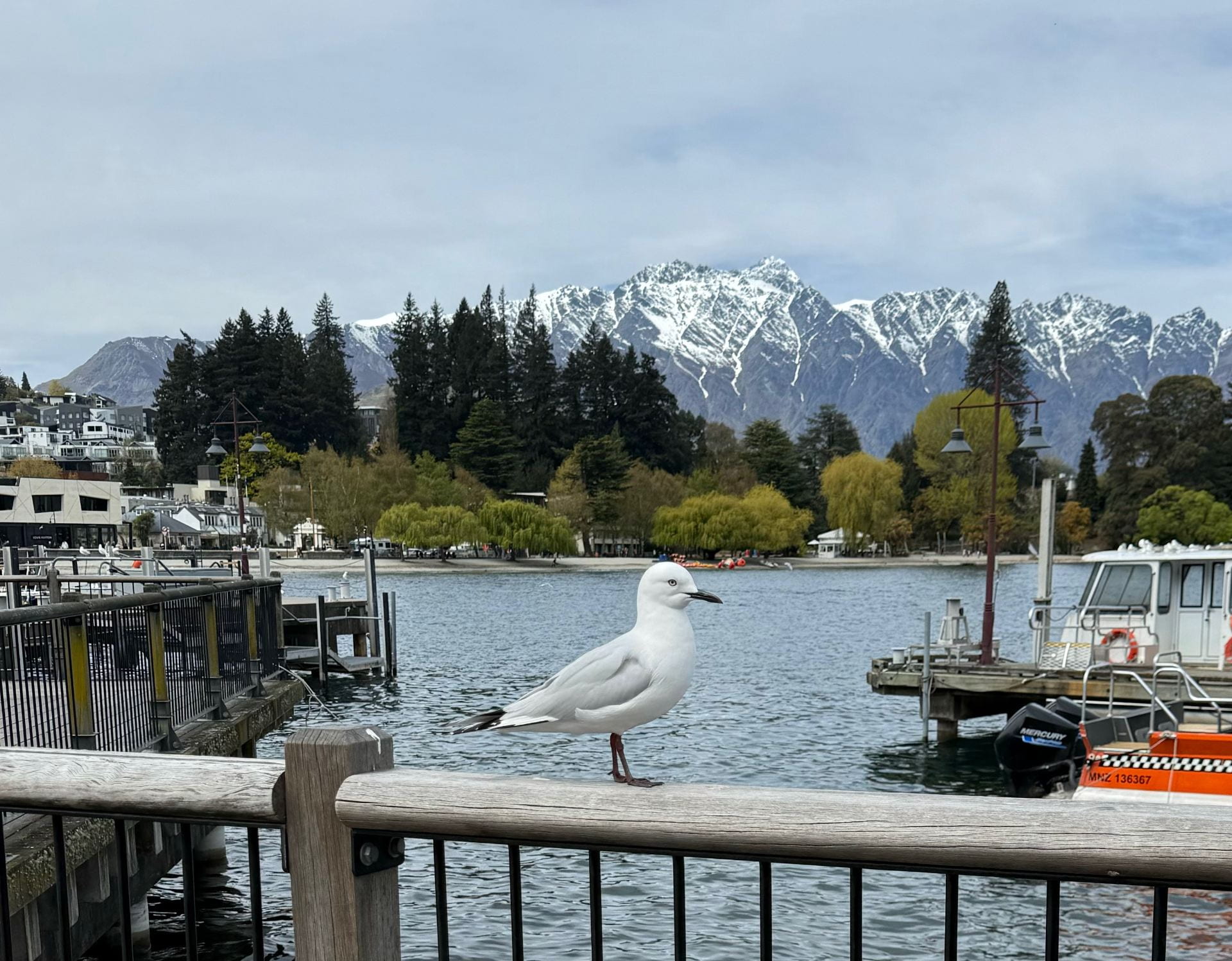
The Queenstown Waterfront in the late evening light
Queenstown is the kind of town that gives older people like us low self-esteem.
Fire-eating on the Waterfront
All the adventurous activities on offer require a daredevil attitude and a willingness to expose one’s body to physical challenges entailing cold water, steep mountainsides, or freezing air.
Some of the businesses that offer death-defying options such as bungy-jumping and paragliding advertise on their shop windows: “Live more, fear less.”
This kind of slogan makes me feel inadequate, yet defiant. I’d rather cling to my fears, thanks very much.
Davey explores the eating options at Steamer Wharf
As a result of my second and Davey’s first dose of Covid, we arrived here in a fragile physical state. Five hours of walking around the town, drinking in the beauty of the waterfront, wandering through the shops and exploring the eating options, wore us out completely. We had to withdraw to our motel and sleep. Clearly, we were not living up to Queenstown’s expectations of us.
Ahh, ginger slice at last. And carrot cake.
Yet the exploring felt like a happy adventure all the same. We found our favourite coffee place, The Outpost in Beach Street, an ethical goods shop offering hand-knitted objects from Nepal and “positive energy” of every artisanal kind. Each day, we popped in to FergBaker to buy some treats for lunch, then sat outside the Outpost to eat, drink coffee and watch the passing parade.
All those young people doing white-water rafting, taking shotover jet boat rides and riding baby luges down the mountain need to have fun, indulge in retail therapy and eat the best fusion food the rest of the time. So they congregate outside Fergburger, visit the restaurants near the Steamer Wharf, wander through the stores of luxury goods, or hang out on the waterfront to watch a fire-eater with burn marks on his arms but a throat somehow magically unaffected by firebrand consumption.
Hanging out in the Queenstown Library to get our energy back
Feeling that we should at least venture something unadventurous, Davey and I took the Skyline Gondola🚠 up to Bob’s Peak, where we admired the panoramic views of Lake Whakatipu and watched all the younger people driving single-person luges down the track. I was expecting whiplash injuries and spinal realignments, because they all drove with happy abandonment and ran into each other quite often, but no one seemed to mind. Instead of endangering our necks and spines, Davey and I took a sedate (but horribly steep) loop walk to admire Ben Lomond from a safe distance. Then, exhausted by our efforts, we sought out our happy coffee place, visited the welcoming library, and finally walked home for a Covid-induced nap.
Queenstown is too young and vibrant for us, but we love it all the same.
– Rosi 😢🤍🖤
Watching the passing parade
A gondola on its way to the Skyline
View of Ben Lomond
Essential Links
The Outpost: For coffee, open-hearted discussions and hand-knitted woollen goods
Skyline Gondola: For panoramic views and choices between sedate walks and luge descents
Davey cooking up chicken curry for our dinner in Katherine
Part 1: Traveller Torture
When we arrived in Katherine after two nights in Kakadu, all the Woolworths assistants were wearing masks, a large crowd was shopping at 3 o’clock on Sunday afternoon, and the bread had completely sold out. We had been mostly without coverage in Kakadu and our phones now flashed us notifications that explained people’s strange behaviour. Darwin had gone into lockdown two hours before our arrival in Katherine, and the premier of South Australia, in a fit of premature panic, had sealed his state from all aliens, or rather, other Australians. The West Australian Premier had sealed his border too.
I am not against carefully restricting the movements of people who have been in a hotspot, but locking everyone out of half of Australia because of one case in a remote mine? If only Australian governments could be more measured in their reactions, more rational in weighing up all the risks involved, more systematic in buying a range of vaccines, and more competent in rolling them out.
“We have nowhere to go,” was a common refrain in the Katherine Holiday Park. I felt for our fellow travellers. Some had booked and paid for accommodation, flights and cruises in the Kimberley; they discovered now that their mere presence in the Northern Territory—not even in a hotspot—would oblige them to quarantine for 14 days at their own expense if they crossed into Western Australia.
We realised that we had achieved the partner look quite unintentionally.
“We could just drive around in circles,” I said to Davey.
“There are no circles in the Northern Territory,” he replied. “There are just roads that take you from north to south or east to west.”
He spends too much time looking at maps, but it can be useful.
For once our lack of planning proved to be a blessing. We had tried to book a site in Alice Springs* but it was lucky that we had failed, since South Australia was no longer a possible way home. The north to south road was out.
So we filled in our Queensland Travel Declaration, downloaded it while we still had mobile coverage, and headed south towards Three Ways to take the road east.
* A Queenslander at Camooweal commented that he expected Alice Springs to go into lockdown, since the mine workers flew in and out of that airport. His words were prescient: the very next day, June 30, Alice Springs also went into a precautionary lockdown.
Part 2: Kakadu
Pink sunset on Yellow Waters
We found Kakadu quite difficult to navigate, perhaps not surprisingly, given its size. Whereas there were simple online fact sheets for both Keep and Litchfield, which provided precise details about all the best short walks in one straightforward file, Kakadu’s documentation was fragmentary and confusing. There were PDFs about some walks, yet without information about the walk’s location in the park and how to get to the starting point. It seemed as though there was no clear overarching plan aimed at making the features of the park as easily accessible as possible.
It looked as though much of the park infrastructure had been set up in the 1980s and then allowed to disintegrate slowly and inexorably. The signage on some of the walks and the tracks themselves clearly needed upgrading, especially when compared to the beautifully maintained signage and tracks at Litchfield.
Kakadu is administered by the federal government, and it shows.
An ancient painting at Ubirr
Yet there is so much that is not to be missed at Kakadu, such as the rock art sites at Ubirr and Burrungkuy (Nourlangie). At Ubirr we had the feeling, as we had at Nigli Gap in Keep, that we were encountering a world from days long gone, a place where people had lived vibrant, mysterious and unimaginable lives far removed from ours.
Ancient rock art at BurrungkuyA lily contrasts with the lush green of the grass.
Mandy Muir of the Murrumbur clan was our tour guide during our cruise on Yellow Waters. She is an Indigenous woman who has family connections in both Kakadu and the Kimberley and who has worked on the wetlands for over 30 years. It was an utter delight to be in her company. She told us of her youth in this magical “backyard” and revealed the depth of her knowledge at every twist and turn of her amazingly manoeuvrable boat.
Mandy could name every kind of bird on the waters, tell us where and how old their nests were, identify the trees where their young were about to spread their wings, and point out hidden inlets where crocodiles were hunting barramundi in plain sight. At one point, as a crocodile was closing in on its prey, the barramundi in danger from those mighty jaws leapt over the scaly body and fled into open water. It seemed that our tour guide knew exactly where to take us so that we could watch the wetland creatures and appreciate their idiosyncrasies.
A paradise for birds
As we drove through the waters teeming with bird life, Mandy drew in close to the banks so that we could snap shots of the fat crocodiles lying along the muddy edges. She also provided insights into the difficulties of administering the park and touched on the problems caused by feral animals such as buffaloes. Her warmth, humour and generosity were as memorable as the wetlands themselves.
A crocodile on the bank of Yellow Waters – we saw many of them sunning themselves and making no attempt at camouflage.
Katherine Holiday Park (they clean the kitchens here!—always chockablock, but professionally run)
Banka Banka Station (the COVID crisis put paid to the evening damper, but we loved this spot—our last night in the NT)
A List of the Birds We Saw on Yellow Waters:
Jabirus, egrets, brolgas, snake-necked darters, brolgas, spoonbills, magpie geese, plumed whistling ducks, white-bellied sea eagles… There were others but I didn’t catch all their names!
A Pertinent Quotation from the Ever-Quotable Katherine Murphy:
The default in Australia throughout this pandemic has been risk aversion. (The Guardian, 30-6-2021)
Sun over Yellow WatersAnother view over the wetlandsA snake-necked darter looks over its territory.A view over Banka Banka Station, our last overnight stop during our hasty exit from the Northern Territory


 A gondola on its way to the Skyline