On the Way Home

The Warrego River near Cunnumulla

Part 1: Surviving the Cold Nights in Outback NSW

My new, beloved sleeping bag is supposed to provide comfort down to -6 degrees and ensure survival to -13, but I start to feel slightly less than completely warm at zero to one degree, which seems to be a common overnight temperature in western NSW at this time of year.

This loss of perfect comfort, however, only becomes noticeable after I leave my feather-down refuge to visit the facilities at 5 in the morning and then return shivering to our tent. Those visits to the outside world are like Harry Potter plunging into the freezing pool to retrieve the sword of Godric Gryffindor, except that, unlike Harry, I’m not brave at all—I’m more of a Hufflepuff type.

The facilities and bush artefacts at Billy’o Bush Retreat
Preparing for the icy night in Wongarbon: The hot water bottle and woollen socks (in addition to my magical sleeping bag) kept me toasty warm all night long .

After the foully unappealing caravan park in Longreach, David had wisely booked campgrounds in regional NSW outside the major towns. Unfortunately, we experienced only two of his choices, Kidmans Camp in North Bourke and Billy’o Bush Retreat,15 kilometres out of Dubbo in Wongarbon. Both were welcoming, delightful places, ideal for my research into how to survive freezing temperatures in a tent. On our last night, I discovered that a hot water bottle, woollen tights, and the knitted socks made for me by my German-French friend, Moni, insulated me from the creeping cold of the early morning.

Sad to say, that was to be my last chance for night-time research…

Part 2: Our Last Frenetic Day
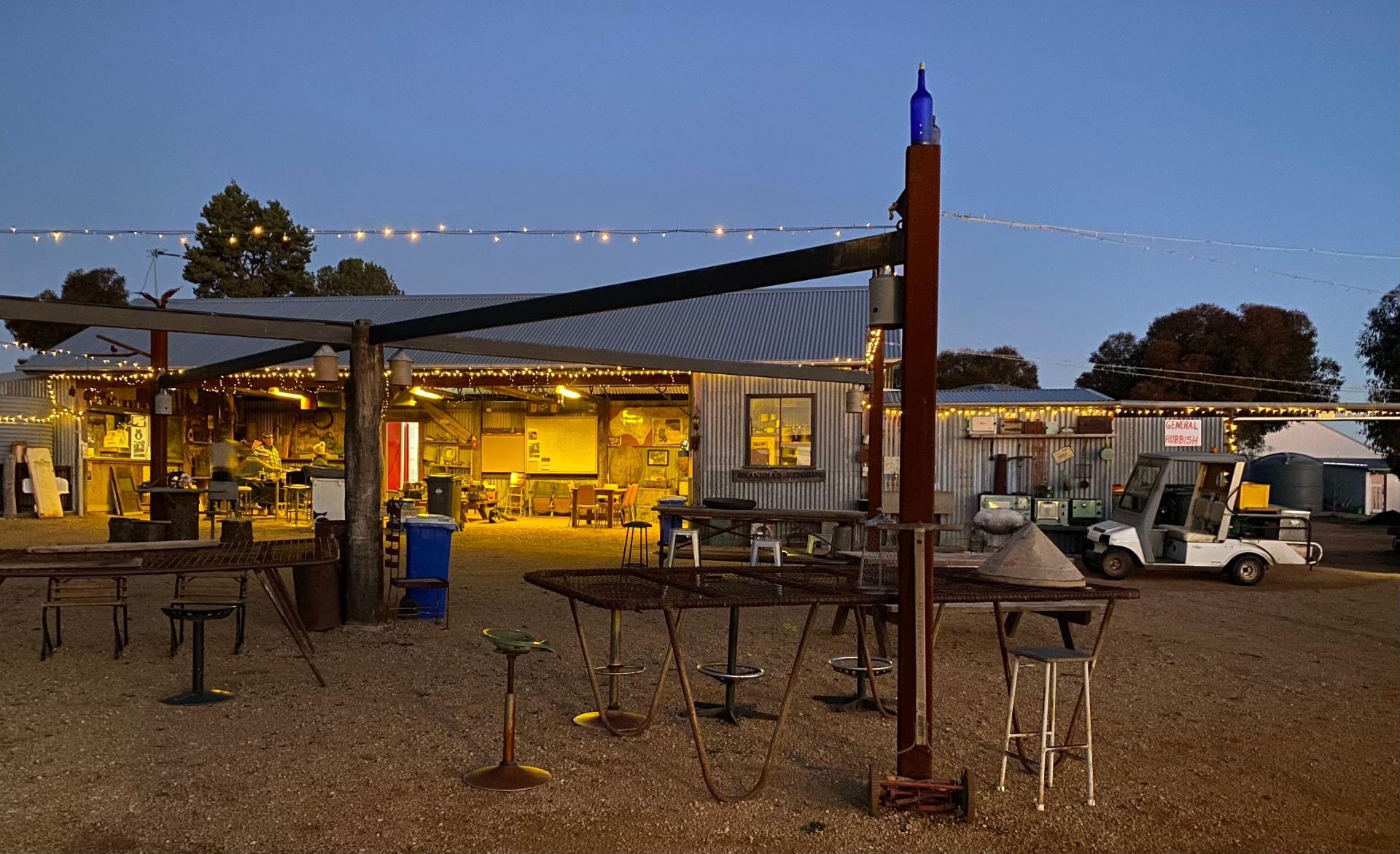
The bar and kitchen at Billy’o Bush Retreat near Dubbo, where the owner, Mark, wore a tee-shirt with the words “Go to Billy’o!”

David and I had kept an eye on the worsening COVID situation in Sydney and checked in frequently on the Victorian border pass website, but it was only on Sunday morning, 11 July, that the notifications on our phones, along with our friends’ text messages, became urgent enough to make us think that we had no choice but to head for home and give up our plans to visit Parkes and Jerilderie. 

David had booked us tickets for the Royal Flying Doctor Visitor Experience and the Western Plains Zoo in Dubbo. As we visited each one, we were on tenterhooks, checking our phones, watching parts of press conferences, and hoping that we could indeed indulge ourselves with this one last day.
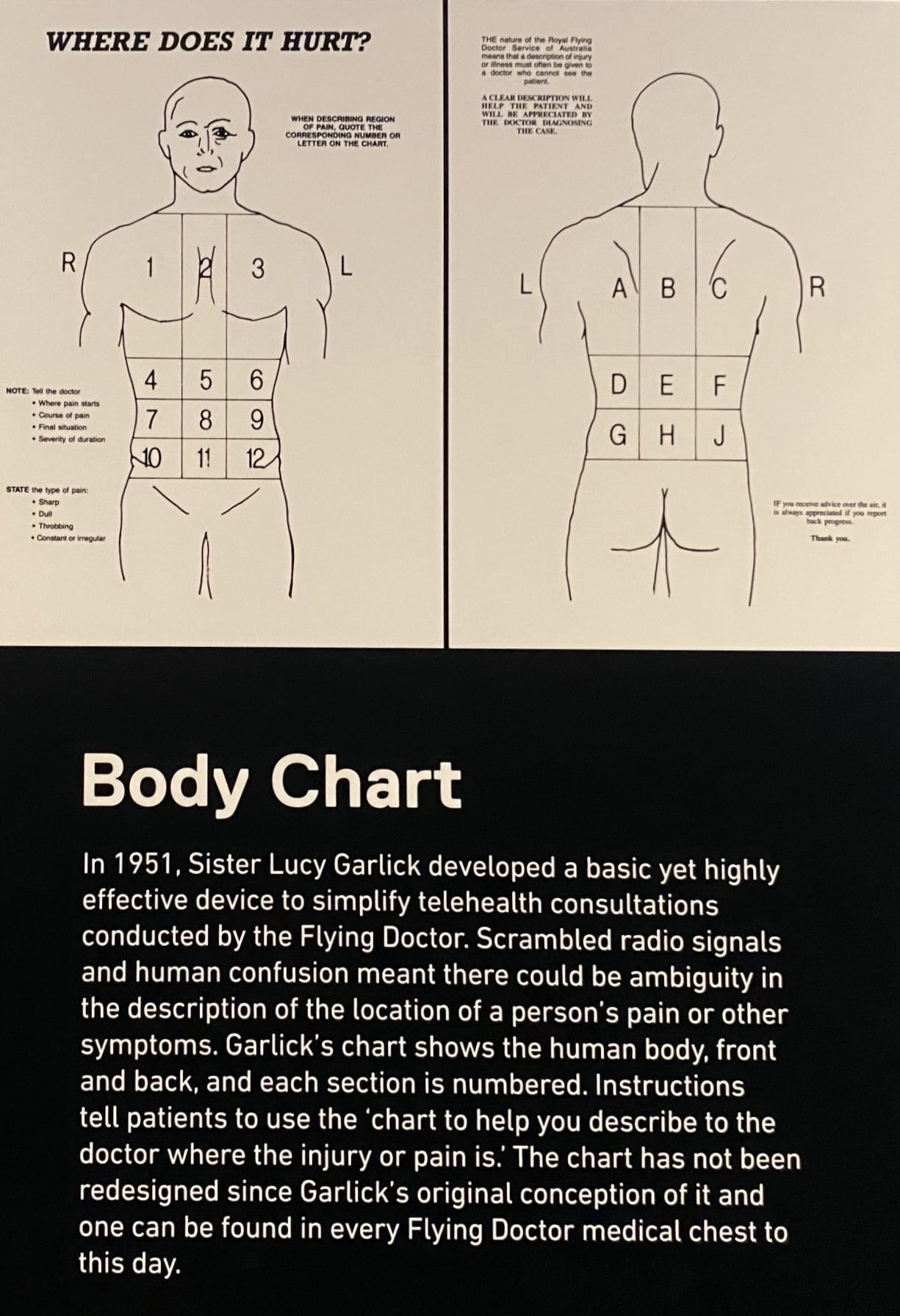
A simple, clever idea employed by the Royal Flying Doctor Service

The Flying Doctor exhibition was eye-catching and engaging, with an emphasis on the history of the service, the extensive areas now covered, and the simple, clever ideas that have been developed to improve the lives and care of people in remote areas. There were many personal stories, both inspiring and distressing. Some bush people describe gruesome injuries with self-deprecating humour and airy nonchalance. One man had lost his lower leg in a farm machinery accident and had only survived through the work of the Royal Flying Doctor Service. He said wryly that he could just about have Frequent Flyer rights. 
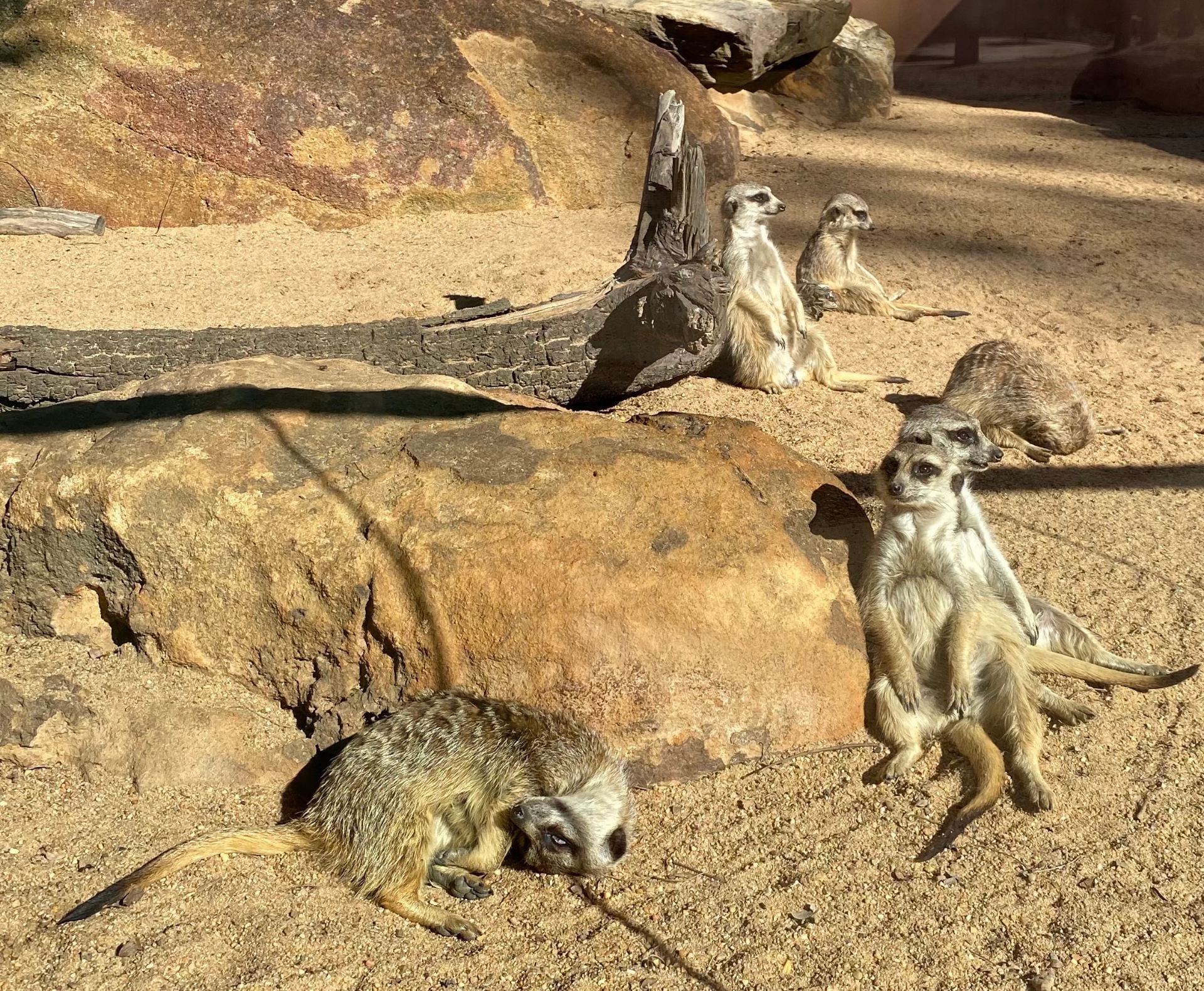
If only I could emulate the relaxed attitude and stance of the meerkat on the left!

Time was slipping away by the time we reached the Western Plains Zoo. We had been vacillating all day between leaving for Victoria immediately or staying one more night at Billy’o. Viewing the animals and reading about their characteristics served as a soothing distraction. The meerkats looked as though no political or bureaucratic decision would ever faze them. The details about the mating behaviours of cheetahs and Galapagos tortoises also allayed my anxieties briefly. The male tortoise has such poor eyesight that he has been known to try to mate with a stone, if it only resembles a female closely enough. If this hadn’t been written by a zoologist, I never would have believed it.

On the way home to Billy’o we decided that we might as well pack up our tent and leave for Victoria straightaway rather than wait until the following morning. Just as we finished packing, a notification came through that the border was to be closed at midnight.

It was a beautiful sunset as we were driving to the border, but I wouldn’t let Davey stop…

That 6-hour drive through the darkness, the roadworks, the fog and the stillness of the outback was like a forced march. We had about an hour up our sleeves, but I kept imagining the worst, as I typically do. David was sunny and optimistic, while I pictured smashed windscreens, punctured tyres and unexpected collisions.

When we reached the border at Tocumwal at last, it was utterly deserted and eerily quiet. We had expected a checkpoint with masked police, flashing lights, QR-readers and bottles of sanitiser. There wasn’t even a witch’s hat.

Well, really. After all that.

Davey’s brand new slippers from Jassi Leatherworks

Luckily, Victoria is quite small compared to the rest of Australia. We had only about three hours left to drive home, and when we arrived David’s new slippers, ordered from Jassi Leatherworks near Denmark in Western Australia, were waiting in the dark kitchen to receive us. They would have come in handy in outback NSW.

Final Notes:

Total Kilometres: 19,259

Accommodation:

Our trip around Australia (map created through David’s WikiCamps app)

Part 3: Campground Inhabitants

The Five Most Likeable Campground Inhabitants

1 The man who stopped us just in time from driving off while our fridge was still plugged in (this happened more than once);
2 The older woman in a velour dressing gown who didn’t mention a single travelling experience and admitted that she spent a lot of time reading;
3 The other cooks who admired our collapsible cookware, the only equipment we possess that ever elicited positive remarks;
4 The person who warned us that we would need a G2G pass for Western Australia, even when there was not a single COVID case in the whole country;
5 The quiet couple in a modest camper van who turned up unexpectedly at the same campsites and greeted us on each occasion rapturously and by name.

The Five Most Annoying Campground Inhabitants
1 The woman who face-timed with several friends and family members in the camp kitchen—or in any other crowded or highly audible location (this happened more than once);

“Oh darling, the cruise was lovely but the food was a disappointment. And the wine too. For $350 I expected better.”

2 The man who spoke loudly, piercingly and incessantly about his successful adventures and travel experiences; 

3 The woman who told us where we should have gone on our trip and who sighed deeply when we told her that we had missed that magical location she had just mentioned, now 1000 kilometres away;

“What, you didn’t go there? Oh, but you don’t know what you missed! You really should have!”

4 The child whose shrill screams cruelly penetrated our consciousness and who then switched to ear-splitting weeping when not sufficiently indulged by his or her hapless parents;

5 The couple who regaled us with stories about the outstanding qualities of their rig, 4WD and general equipment.

“And then we thought, why not just spend the $90,000? Our kids don’t need it and we deserve some luxury.”

From Longreach’s Dreamers to Charleville’s Starry Nights

David (looking rather thin from all our camping exertions) at the Qantas Hangar at Longreach

Where not to camp: Longreach Tourist Park was all gravel and slush

We were out of Longreach Tourist Park by 8.30 in the morning and I was glad, for it was the most featureless, least prepossessing campground that we had ever encountered. There was no grass, only gravel, and the rigs were packed as tightly as fat lambs in a dusty yard being drafted for market.

To make matters worse, some caravan owners released their grey water directly onto the unmade tracks between each packed block of caravans, thereby creating puddles in which children paddled. Eww.

Some bright spark in the landscaping department had decided to make several decorative fake rocks to scatter around, rather than plant trees. That sums up the type of place it was.

We had been drawn to Longreach by the Qantas Founders Museum just outside the town, which I enjoyed more because of the human stories than the aviation details. All the same, I tried very hard to pay attention during our tour of the hangar, led by a passionate young man called Jonathan, who had been involved in working bees there from the age of 4. His knowledge of 747s, one of the planes we toured, was encyclopaedic. He explained how the lavatory hatch worked and I was relieved to discover that the waste products were piped out and disposed of responsibly (unlike the grey water at Longreach Tourist Park, sorry for harping). Getting within three metres of a running motor, Jonathan informed us, would be dangerous, since you could be sucked into the works.

The first ever Qantas plane

One of the children asked: “You mean you will never come out?”

Jonathan replied: ““I mean, you’ll come out. You’ll just be in lots of little bits.”

This reminded me of my former life as a teacher, when answering fundamentally unanswerable questions could lead to cheery absurdities and farcical exchanges.

From Jonathan I learned that a 747’s maximum weight for taking off was heavier than for landing; that a 747 flew 19,000 cycles (taking off, flying somewhere and landing) before being retired; and that a single new tyre cost $3000.

My favourite piece of aviation trivia was the story of the Captain Cook Lounge, an early luxurious bar provided upstairs near the cockpit for first-class passengers to sit, drink and feel important in, until someone realised that this was no way to make money. It is somehow both ironic and satisfying to learn that this ultimate proof of our anything but classless society should have been scrapped to fulfil capitalistic ambitions.

The Captain Cook Lounge

The founders of Qantas seemed to be surprisingly humble men who perceived a future in aviation even while others doubted their vision. They wanted to overcome the tyranny of distance, an aim that I can just dimly appreciate after travelling in relatively comfortable circumstances around this vast land. One wag in Longreach evidently quipped in the early years that the original Qantas hangar would be more useful as a shearing shed. Yet the founders persisted.

Bush choreography at the Charleville Bush Caravan Park

The isolation of the outback was a motivating force in the founders’ dream. The part of the museum that I liked most was the oral histories about the lonely lives of women in the outback. One woman treated her burns with mutton fat and kerosene. Another raised two young boys on her own in the bush while her husband was mostly away working, but when her infant daughter died, she could bear it no longer. I would have escaped long before she did.

Creative cogs at the Charleville Bush Caravan Park

After we set up our tent in the Charleville Bush Caravan Park (not one puddle of grey water), we shot off to the Cosmos Centre to look at the stars with the help of Cam, a guide who reminded me of the professor in “Back to the Future”. He was just as loveably geeky as the fossil scientists of Riversleigh and he was as familiar with the night sky as I am with my best-loved knitting patterns.

With the help of a 30-inch reflector telescope mounted in our little real-life planetarium, we looked at the sky through Cam’s eyes and saw, as Banjo Paterson described it, “the wondrous glory of the everlasting stars”*. Among other distant phenomena, I looked at one of the stars of the Southern Cross beside a smaller red dwarf that would not normally be visible to the naked eye. The first star was bright and brilliant, the second slowly burning out its dying energy.

Our tent in the garden at Winton Wanderers Caravan Park

I am becoming weary of travel, while David is as eager and energetic as ever. Whereas I just want to get through the “orange zone” of NSW, have a COVID test and then isolate myself in our heated lounge room, he is still busily googling, booking activities and planning our life in the cosmos. I am swept along by his enthusiasm. In our shambolic team, Davey is the bright and sparkling star in the Southern Cross, while I am gradually losing my powers like that fading red dwarf.

* From “Clancy of the Overflow”

Final Notes

Accommodation:

The cooler days are speeding up my knitting projects.

If Only:
As we drove through the little town of Ilfracombe, only 25 kilometres further along the Landsborough highway from Longreach, we saw a grassy, homely little campground (see the picture at this link) near a welcoming pub. If only we had stayed there instead of in the crowded, soulless paddock at Longreach, we thought.

Corrugated iron wall painting in Augathella
Deb’s instant mash and David’s beef stroganoff at Winton Wanderers

Mt Isa and the Fossils of Riversleigh

An artist‘s representation of a short-nosed kangaroo: By falling into this cave, the poor creature had escaped from the marsupial lion (see picture below) but was fated to die and become a fossil.

♦  —  ♦  —  ♦  —  ♦  —  ♦

“What exactly is ‘guano’?” I asked.

“Shit,” David replied.

He has such a poetic turn of phrase.

The many species that have been identified through the work at Riversleigh

We were reading a placard in the Fossil Discovery Centre in Mt Isa about the work of palaeontologists at Riversleigh, about 250 kilometres to the northeast. Our original plan had been to do a mine tour in Mt Isa, but in the past week outback Queensland had become a crowded conduit for the displaced travellers in the far north of Australia. The mine tours were booked out for days on end.

Shallow as I am, I feel much the same way about mines as I do about dams, so I didn’t really care, but I was disappointed for David’s sake.

The scary “killer kangaroo”, which evidently galloped rather than hopped

The Fossil Discovery Centre was our alternative tourist activity and I was discovering that it was by no means a second-rate consolation prize. Like all the best museums and exhibitions, it was carefully conceived, meticulously presented and genuinely captivating.

If there is one thing that reassures me that life has a purpose and that it is worth continuing to strive and exist, it is the loveable geekiness of scientists. They take up some obscure branch of knowledge that may never touch the lives of ordinary people and then pursue it with the kind of passion that convinces me, almost beyond doubt, that human nature has more than a grain of goodness and decency in it.

In fact, such scientists demonstrate that we live not just to produce excrement but also to perceive, to dream and to comprehend all mysteries.

I am grateful not to encounter these giant birds as I visit the facilities on a dark night in the Outback.

This brings me back, however circuitously, to the guano question. Guano refers in this case to bat waste. Layers of bat excrement, along with the lime-rich rock in the Riversleigh area, had helped preserve the bones, jaws and skulls of frogs, birds and marsupials, along with the soft tissues of insects, snails and plants—almost from the moment that these living things died. The conditions at this particular site were simply ideal for the formation of fossils.

As a result of its dense fossil formations, Riversleigh has been recognised as a world heritage site and has lured palaeontologists from all over the world. These scientists can draw conclusions from the perfectly formed fossils in this region about the last thirty million years of animal evolution in Australia.

Who would ever have thought that bat excrement could contribute so significantly to human knowledge?

The marsupial lion: In the cave diorama, he was shown staring down at the short-nosed kangaroo, which had fallen out of his reach (but into the claws of future scientists).

The exhibition was a creative masterpiece, with many eye-catching representations of long-extinct relatives of modern animals: the short-nosed kangaroo, the killer kangaroo, a koala that was half the size of the modern version but with a broader diet, the diprotodon (a giant wombat-like marsupial) and so on. Then there were the extinct animals with no modern relative, such as the marsupial lion and the giant birds, known in the vernacular as the “demon ducks of doom”. Finally, some fossils were too insubstantial for confident extrapolation of their characteristics. One was given the provisional name of “thingodonta”.

David and I wandered happily through the superb dioramas, one in the form of a cave, one a forest filled with prehistoric animals with placards to help us identify each one. There was even a little waterfall.

I wanted to say to David: “Isn’t this far better than a mine?”

But I didn’t want to seem heartless, so I asked him if I could take a photo of him emerging from the cave. My dear old fossil. It was the closest we were going to get to an underground experience. And best of all, there was no guano to be seen.

Human emerging from cave: At first glance, it may seem like a primitive creature, but in reality it is a complex mixture of sophisticated camping behaviours and bike-loving emotions. In the primeval struggle for survival, it is impaired by its lack of protective head hair, but the long proboscis, by providing it with crucial environmental information, especially about the wine it ingests, strengthens its capacity to sustain and enrich its existence.

Final Notes

Accommodation
Discovery Park – Mt Isa (We had our own ensuite. It was pricy but heavenly.)

Podcasts for Our Long, Lonely Drives 
(especially the one from the Northern Territory into Queensland) 
The diprotodon, often described as a kind of giant wombat
A scene from the forest diorama, showing that 30 million years ago this part of Queensland was covered by lush forests, a rich diversity of fauna and even waterfalls!
Mt Isa’s mine chimneys in the evening light

Back to Katherine—and Phone Notifications

Davey cooking up chicken curry for our dinner in Katherine

Part 1: Traveller Torture

When we arrived in Katherine after two nights in Kakadu, all the Woolworths assistants were wearing masks, a large crowd was shopping at 3 o’clock on Sunday afternoon, and the  bread had completely sold out. We had been mostly without coverage in Kakadu and our phones now flashed us notifications that explained people’s strange behaviour. Darwin had gone into lockdown two hours before our arrival in Katherine, and the premier of South Australia, in a fit of premature panic, had sealed his state from all aliens, or rather, other Australians. The West Australian Premier had sealed his border too.

I am not against carefully restricting the movements of people who have been in a hotspot, but locking everyone out of half of Australia because of one case in a remote mine? If only Australian governments could be more measured in their reactions, more rational in weighing up all the risks involved, more systematic in buying a range of vaccines, and more competent in rolling them out. 

“We have nowhere to go,” was a common refrain in the Katherine Holiday Park. I felt for our fellow travellers. Some had booked and paid for accommodation, flights and cruises in the Kimberley; they discovered now that their mere presence in the Northern Territory—not even in a hotspot—would oblige them to quarantine for 14 days at their own expense if they crossed into Western Australia.

We realised that we had achieved the partner look quite unintentionally.

“We could just drive around in circles,” I said to Davey.

“There are no circles in the Northern Territory,” he replied. “There are just roads that take you from north to south or east to west.”

He spends too much time looking at maps, but it can be useful.

For once our lack of planning proved to be a blessing. We had tried to book a site in Alice Springs* but it was lucky that we had failed, since South Australia was no longer a possible way home. The north to south road was out.

So we filled in our Queensland Travel Declaration, downloaded it while we still had mobile coverage, and headed south towards Three Ways to take the road east.

* A Queenslander at Camooweal commented that he expected Alice Springs to go into lockdown, since the mine workers flew in and out of that airport. His words were prescient: the very next day, June 30, Alice Springs also went into a precautionary lockdown. 

Part 2: Kakadu

Pink sunset on Yellow Waters

We found Kakadu quite difficult to navigate, perhaps not surprisingly, given its size. Whereas there were simple online fact sheets for both Keep and Litchfield, which provided precise details about all the best short walks in one straightforward file, Kakadu’s documentation was fragmentary and confusing. There were PDFs about some walks, yet without information about the walk’s location in the park and how to get to the starting point. It seemed as though there was no clear overarching plan aimed at making the features of the park as easily accessible as possible.

It looked as though much of the park infrastructure had been set up in the 1980s and then allowed to disintegrate slowly and inexorably. The signage on some of the walks and the tracks themselves clearly needed upgrading, especially when compared to the beautifully maintained signage and tracks at Litchfield.

Kakadu is administered by the federal government, and it shows.

An ancient painting at Ubirr

Yet there is so much that is not to be missed at Kakadu, such as the rock art sites at Ubirr and Burrungkuy (Nourlangie). At Ubirr we had the feeling, as we had at Nigli Gap in Keep, that we were encountering a world from days long gone, a place where people had lived vibrant, mysterious and unimaginable lives far removed from ours.

Ancient rock art at Burrungkuy
A lily contrasts with the lush green of the grass.

Mandy Muir of the Murrumbur clan was our tour guide during our cruise on Yellow Waters. She is an Indigenous woman who has family connections in both  Kakadu and the Kimberley and who has worked on the wetlands for over 30 years. It was an utter delight to be in her company. She told us of her youth in this magical “backyard” and revealed the depth of her knowledge at every twist and turn of her amazingly manoeuvrable boat.

Mandy could name every kind of bird on the waters, tell us where and how old their nests were, identify the trees where their young were about to spread their wings, and point out hidden inlets where crocodiles were hunting barramundi in plain sight. At one point, as a crocodile was closing in on its prey, the barramundi in danger from those mighty jaws leapt over the scaly body and fled into open water. It seemed that our tour guide knew exactly where to take us so that we could watch the wetland creatures and appreciate their idiosyncrasies.

A paradise for birds

As we drove through the waters teeming with bird life, Mandy drew in close to the banks so that we could snap shots of the fat crocodiles lying along the muddy edges. She also provided insights into the difficulties of administering the park and touched on the problems caused by feral animals such as buffaloes. Her warmth, humour and generosity were as memorable as the wetlands themselves.

A crocodile on the bank of Yellow Waters – we saw many of them sunning themselves and making no attempt at camouflage.

Final Notes and Comments
Accommodation

A List of the Birds We Saw on Yellow Waters: 

Jabirus, egrets, brolgas, snake-necked darters, brolgas, spoonbills, magpie geese, plumed whistling ducks, white-bellied sea eagles… There were others but I didn’t catch all their names!

A Pertinent Quotation from the Ever-Quotable Katherine Murphy:

The default in Australia throughout this pandemic has been risk aversion. (The Guardian, 30-6-2021) 

Sun over Yellow Waters
Another view over the wetlands
A snake-necked darter looks over its territory.
A view over Banka Banka Station, our last overnight stop during our hasty exit from the Northern Territory

A Bed at Last – Darwin

A colourful croc on a Darwin wall


A bed at last!

We slept in our little tent for 50 nights straight between our cabin in Ravensthorpe and our hotel in Darwin.

During that time, I didn’t fantasise about beds at all. Well, only occasionally.

All the same, sleeping in the Cavenagh Hotel room in Darwin undoubtedly had its pleasures: stretching out in bed, napping during the late afternoon in an air-conditioned room and, most luxurious of all, having a toilet only 3 metres away.

Jabiru – street sculpture by Indigenous artist, Janice Pungautiji Murray

Our room was rather dark, with a skylight but no windows. It was the exact opposite of being in the natural world. To my surprise, even while I enjoyed the comforts of city living, I missed waking up with the dawn and listening to the birds.

There were of course many consolations, especially the fleshpots of the inner city. All the way along Knuckey and Bennett Streets were diverse restaurants, bars and ice cream shops, rocking even on Monday night. We particularly liked Moorish, with its hints of Northern Africa and Spain, and Johnn Johnn’s for a dessert ice cream.

Art through projections of light – by a Darwin Indigenous artist, Dotty Fejo

On every street there were references to the Larrakia people, the traditional owners of Darwin, who number about 2000 and who have survived and prospered, like Darwin itself, against the odds. We were astonished by the quality and abundance of Aboriginal art works, some originating also from further south in the Northern Territory. If only our house still had some empty walls and the kinds of spacious rooms that might give those representations of the outback due impact.

As the target of human foes and the victim of natural disasters, Darwin has a rich modern as well as ancient history. At the Darwin Military Museum, I discovered that in 1938 it took nine days to fly from Sydney to London, with Darwin as the last Australian stop. The Japanese attacks from 1942 onwards were far more frequent and widespread than I had ever assumed; the raids continued for 20 months after 19 February, 1942, and included towns as far flung as Broome, Derby, Townsville and Exmouth. Although the loss of life and destruction of property at Pearl Harbour were far greater than during the first raid on Darwin, there was a similarity between the two attacks, in that each struck an unsuspecting population and brought a foreign war back home.

The location of Japanese raids in the twenty months after February, 1942

The introductory film about the first Japanese attack was moving and cleverly conceived, with old footage brought to life by additional modern effects such as flames curling around ships and buildings. One of the saddest parts of the film was the story of the nine workers in the Post Office who were killed outright.

When David pressured me to visit Parliament House, I replied snootily that I doubted it would be worth the effort, but I was wrong. The former upper house had been converted into a library, a quiet and appealing space offering respite from the infernal, draining heat outside; it was adorned with paintings, documents, commemorative quilts, historical references, and wall posters of lucidly explained information. All upper houses in Australian states should share the same happy fate.

Insights into how women’s magazines portrayed the situation in Darwin after Cyclone Tracy in 1974 – from the Upper House Library

Having taken advantage of numerous services in Darwin, including an optometrist, a car mechanic and a hair stylist, we felt ready to roll out our tent again for the long drive south*—and in my case to wake up once more with the sun and the birds.

♦ ♦ ♦ ♦ ♦ ♦ 

* At the time of writing this post, we were planning to drive home via South Australia to avoid the COVID outbreaks in the eastern states. That idea came to a sticky end.

We left Darwin 2 and a half days before it went into lockdown. Sheer dumb luck.

Davey takes a break in one of the seats hewed out of a tree that are placed invitingly around the Darwin Botanic Gardens.

Final Notes and Comments
♦ Accommodation
The Cavenagh, 12 Cavenagh Street, Darwin (ideal location in the town centre)

Fun Fact from the Military Museum: The word “jeep” comes from “GP” for “general purpose” vehicle. Initially, I thought that this might be an urban myth, but it was corroborated by my Oxford app.

♦ The Botanic Gardens represented many different habitats, including rainforests, eucalyptus woodlands, Tiwi wet forests and Madagascar baobabs, with a guest appearance by our own beloved boab, Adansonia gregorii.

Only one of them is the Australian boab – the one on the top left. I actually didn’t think that it looked all that typical of the boabs I had seen in the Kimberley, which were generally taller and stockier, as shown by the information board reproduced below:

Artwork and poster depicting the “Uluru Statement from the Heart” – in the Upper House Library
St Mary’s Catholic Cathedral, built to withstand cyclones, yet inviting and architecturally cohesive as well.
A Darwin resident saved a desert rose from demolition by a developer and delivered it to the Botanic Gardens, where it now has pride of place.

Not Really Roughing It – from Kununurra to Katherine

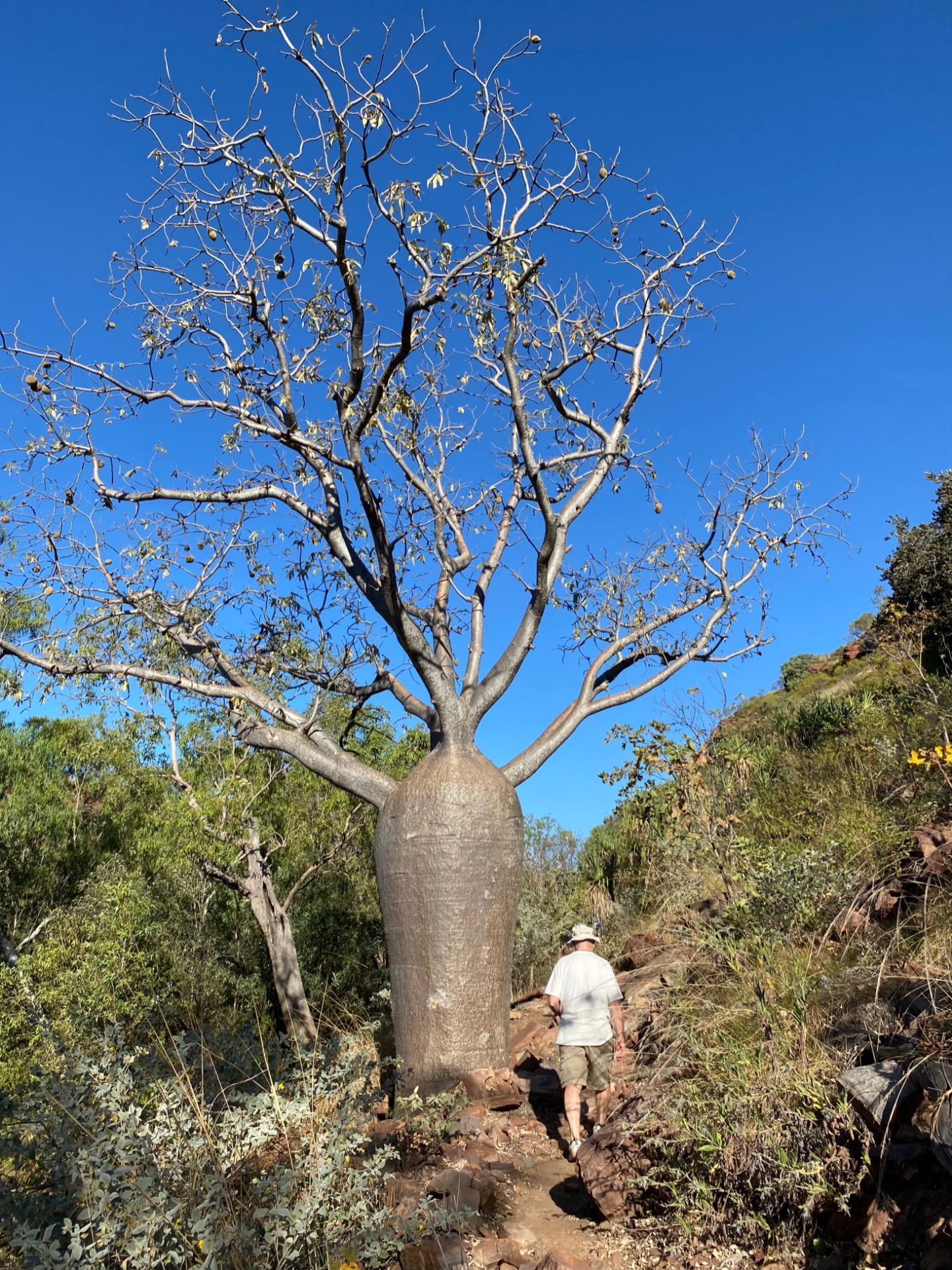
David on the Jenemoom Walk, Keep River National Park. I especially like this boab tree because its shape is so like a wine bottle’s.

Sometimes I feel moderately pleased with myself for travelling around Australia in a medium-sized SUV with a medium-sized husband and a medium-sized tent. Then I meet other travellers whose conception of the journey is far humbler and much more exacting than ours.

When we visited Keep River National Park, we saw mostly campers at the lower end of the comfort scale. At Jarnem Campground, the campers were either other tent-dwellers or owners of camper trailers, which represent the next step up from tents in the comfort hierarchy. Although Keep was accessible to all kinds of vehicles and eminently worth visiting, it was largely ignored by the big caravan dwellers who had packed the park in Kununurra. It was as though many of them had restricted themselves to the comforts of town life, perhaps in order to avoid the undeniable messiness of bush camping—despite the built-in luxuries they could have towed along to soften the experience.

Rock shelter used by the Miriwoong people in the wet season

David and I had planned two walks at Keep: one in the cool of the evening and the other at dawn. We began the “Jenemoom Walk” at four in the afternoon, which was actually far too early. Since all our gadgets had ticked over to Northern Territory time, one and a half hours later than the time in Kununurra, we had falsely assumed that the sun would play by the same rules. It was still burning hot. Whenever I was in the full sun, I felt as though my arms were roasting on a rotisserie. Fortunately, we were walking at least some of the time in the shade of the rocky cliffs towering over us. We coped by drinking frequently and sweating copiously.

At the end of the walk, which took us along the edge of an almost dry creek bed, we came to a huge overhanging rock that was used in earlier times by the Miriwoong people as a shelter in the wet season. We could see the hollows in some flat stones on the ground where the people had pounded seeds to make a kind of flat bread. It was a quiet, mysterious place, imbued with the secrets of the deep past.

A mortar stone with a hollow caused by seed grinding – from the wet season shelter of the Miriwoong people, Jenemoom Walk, Keep River National Park
Dawn breaks over the “Bungle-like” sandstone formations on the Nigli Gap Walk.

The early morning walk led us to Nigli Gap along the base of the Jarnem escarpment. The dawn sun cast a golden glow over the tops of the sandstone formations, leaving the rest in shadow. At the end of the track we came to a rock wall with ancient paintings in red ochre that also seemed to whisper to us from long ago. 

Paintings in red ochre at Nigli Gap

We were covered with red dust when we returned to our campground, yet filled with the sense of self-denying achievement that comes from rising before the sun. “I’m going for more walks at dawn when I get home,” I told David.

“Yeah, yeah,” he replied. Such a cynic.

The magic light effects of a dawn walk – but shall I have the motivation to try it in Melbourne? Davey doubts it.

Our pride in our efforts was tempered later that day by our encounters with other campers in Timber Creek, nearly 100 kilometres further along the highway to Darwin. We met two women who had cycled from Melbourne (“up the guts”, they said, not across the Nullarbor like us) and who had set off only 2 weeks before we had. They looked to be in their fifties.

“You two must have more brawn than brains,” commented an older man in the camp kitchen.

“Not much brawn,” one of them replied—and it was true. They looked neither muscular nor particularly athletic. Yet every day they managed 100 kilometres or more on their electric bikes, carrying all the necessities of life with them, including solar panels with which to charge their bike batteries when they camped in the bush. David saw one of them the following morning with a 15-litre soft pack of water—yet another heavy object to be carted in tropical heat over vast distances on their bike trailer.

Bungle-like formations and a boab in the early morning on the Nigli Gap Walk

Another couple in Timber Creek, clearly older than David, were travelling with just a car and a double swag. I saw them in the early morning, lying side by side in the pale light, chatting quietly. I was seriously impressed by their modest equipment and their gentle companionship. David and I prefer not to communicate more than absolutely necessary before breakfast.

All in all, we have to conclude that our method of travelling is somewhere in the middle of the scale. We may have renounced certain comforts, but compared to some people our style of camping involves substantial self-indulgence.

Final Notes

Accommodation:

Entmoot at sunset, Kununurra
Emu in red ochre, Nigli Gap Walk
The fruit of the Pandanus Palm, looking like Christmas tree decorations—or hot coals from a fire
The pith of a boab nut, originally on the ground at Jarnem Campground
Wet season shelter information board, Keep River National Park
A view of Katherine River from the Baruwei Lookout, which we climbed unwisely in the heat of the afternoon. How I longed to be chugging along in that happy little boat of revellers…

Options and Encounters – from Derby to Kununurra

Davey always asks for extra froth on his cappuccino. They take him seriously up here.

“It goes against the grain to outlay all that money,” I said, “but I’m prepared to go on the $190 cruise.”

David demurred. “The $299 one is better.”

We were discussing possibilities for an Ord River cruise from Kununurra, a town that only came into existence in 1961 as a by-product of the dam project. 

“That tour doesn’t even give you an extra meal for the extra $110,” I argued. “Just nibbles and a glass of champagne.” 

“Yes, but you get to see Lake Argyle as well as the Ord River.”

“So what? It’s just a dam.”

This was like secular blasphemy to a lover of dams and other feats of engineering. “It holds 21 times as much water as Sydney Harbour,” David cried. He flapped the brochure about in the early dusk and his unkempt beard fluttered in the Kununurra breeze. “I want to see it. I don’t want to miss it.”

I had to give in. You can’t stand between a man and a dam. 

Lake Argyle pours water into the Ord River. To the right is the stony “plug” that forms the dam wall between the mountains.

Sadly for David and for my dam education, his desired tour was booked out and we had to settle for the one I’d originally chosen. This is what happens when so many Australians are travelling at the same time. We did see and admire Lake Argyle, but not for quite as long as he had hoped.  

The sandbar near the junction of the Fitzroy and Margaret Rivers

Before this heated discussion, we had spent a few days and nights travelling ponderously along the highway from Derby to Kununurra. On the whole, the road had been quiet and lonely, but not without its idiosyncrasies and its pleasures. We had driven over any number of one-lane bridges spanning creeks that only have water in the wet season, and we had navigated, as usual in Western Australia, many kilometres of roadworks. We had stayed overnight in Fitzroy Crossing, at Larrawa Station (not a patch on Bullara Station) and at Doon Doon Roadhouse

Sunset at Larrawa Station

Other travellers had told us to avoid stopping overnight at Halls Creek because of its “security problems”, but it was at the Poinciana Roadhouse there that we had one of the most memorable moments of the whole trip. We met an Aboriginal man, Ivan Bridge, exactly David’s age, and he told us about his childhood and life on a cattle station as the son of an Aboriginal woman and an Irishman. His father, unlike many other white people at that time,  had encouraged him to speak his mother’s language, Kija. I asked him to speak to us in it. The sentence that he chose, and kindly repeated when I asked him to, was: “I am speaking to you from the mouth of my mother.” 

I would have liked to undertake an intensive language course for weeks on end. 

But back to our river cruise. The thing about tours is that you surrender yourself for a whole day to someone else’s planning. After weeks of reaching our own not particularly knowledgeable decisions, we felt liberated. Once we had climbed onto the bus, we were in the capable hands of the tour providers, Triple-J Tours. All we had to do was lean back, enjoy the air-conditioned comfort and await further instructions.

A view of the cliffs and vegetation as we motored along the river

The boat driver and tour guide, Grant, was clearly a lover of dams and of the plethora of living creatures that make their home on the Ord River. He was especially enamoured with the elegance and ingenuity of the dam system that has been developed over the past 60 years. “No pumps!” he said. “It’s all done with gravity. And there’s no concrete in the dam wall either.” The clay in the wall expands and becomes watertight as it gets wet, which seals it in a natural way. Lake  Argyle currently holds 18 Sydney Harbours, but at the height of a particularly heavy wet season, it has held 43. It is one of the largest freshwater lakes in the southern hemisphere.

As the boat twisted and turned along the Ord River and then across Lake Kununurra, we were mesmerised by the towering red cliffs, the trees that nestled on them, seeming tiny in comparison, the emerald green water, the white spray, the reeds swaying in the sunlight, and the spinifex clinging to the rocks. Grant could pick out even the most well-camouflaged wildlife, such as the crocodiles sunning themselves on the banks and the tree branches, and the rock wallabies peeping out from their little caves. There were all sorts of birds too: sea eagles, ospreys, darters, cormorants and jacanas, which Grant nicknamed “Jesus birds”, because they can walk on the floating vegetation. 

A view of Lake Kununurra from the front of our cruise boat

I had to admit that we really did need a boat to see all this, rather than our trusty, dusty car. Yet to my mind, the meeting with Ivan, over a coffee and a Kit Kat at a dingy roadhouse on a seemingly interminable highway, was just as memorable as our river cruise. 

Final Notes

Accommodation:
A fuzzy photo of the jacana bird “walking on water”
A relatively youthful boab in Derby
Cooking gnocchi at twilight on Larrawa Station
Two boabs growing side by side
The “Mini Bungle Bungles” in Mirima National Park

Following the Trail of the Boab Trees to Derby

The Prison Tree, 7 kilometres from Derby
Sunset on Cable Beach

I felt quite relieved to leave crowded Broome firmly behind us. Although it is an attractive town with inviting shops and beautiful beaches, it was simply teeming with tourists—most of them, it seemed, bent on viewing the perfect sunset, riding camels and buying pearls. 

Naturally we are tourists too—but we are such tasteful, low-impact tourists! We try to walk on beaches rather than drive onto them in showy 4WDs. We sleep in a tent rather than in a 24-foot-long mobile home with a two-room annexe, a built-in satellite dish and twinkling fairy lights…

Okay, I’m kidding myself—we are really no different from all the others. But at least we don’t have unrealistic expectations. The woman beside us at Tarangau Caravan Park in Broome, who specialised in facetiming loudly deep into the evening, said to one listener: “All I want is to have a selfie shot with all my friends on Cable Beach with the sunset in the background.” She went on to complain that the sky was not complying with her wishes; the clouds were always in the wrong place.

I mean seriously. David and I don’t expect the sky to rearrange itself just to indulge us.

Well, perhaps occasionally.

A boab in Derby with that distinctive swelling trunk (even in relative youth)

On the road to Derby, the environment was dotted, to my delight, with ever more boabs, and I asked myself why I am so taken with these stocky, imposing, long-lived trees. Is it because they start with slender trunks and gradually grow sturdier, chunkier and more robustly individual with the passing of time? Are they potential metaphors for solid women who are long past the first flush of middle age? Am I drawn to them because, to put it bluntly, they are unashamedly fat like me?

Whatever the reason, the Prison Tree, seven kilometres out of Derby, jolted me out of my fanciful conjectures. In the late 1880s, Aboriginal people were kidnapped from the West Kimberley and forced to work in the pearling industry; this venerable and ancient boab, believed to be 1500 years old, was used as a temporary gaol for the slaves en route and later for those who resisted. When I sent a picture of it with details to my daughter Sophie, she wrote back: “Are you serious? They used trees to imprison people? God, we’re horrible.”

Enough said.

So it was a joy to discover other boab trees without such a disturbing past in the town of Derby itself. They were growing abundantly all over the town and some had been planted in a straight line on the main street: relatively young, flourishing, and unsullied by human cruelty.

Derby certainly had a healthy number of tourists, yet it seemed far less frenetic than Broome. And at the close of day, the sky indulged us, casting a golden light over the bulging trunks of those centre town boabs and creating long shadows on the green grass.

Boabs are the plane trees of Derby.

Final Notes
Accommodation:

Some Details About Boab Trees

  • Our name, boab, is possibly an Australian version of the African word baobab.
  • It is hard to determine the age of a boab tree, since older trees are hollow and have no growth rings. It is believed, however, that the particularly large trees could be thousands of years old.
  • A boab tree can survive drought because it stores water when it rains and swells in diameter. The cavities within hollow trunks or between branches provide water for Indigenous people.
  • Since the wood of boab trees is spongy and fibrous, it is not valuable for timber. This is actually fortunate for its survival.
  • The Nyikina people of the West Kimberley region know how to use the roots, pith and seeds of the boab for food and medicine. The bark can be used generally to make string. The bark from a young tree can be chewed to freshen the mouth and provide fluid.
  • The pith of a ripe boab nut is high in Vitamin C and was used in the past to heal explorers suffering from scurvy.
  • It is unwise to shelter under a boab during a storm. Lightning strikes can cause boab trees to collapse and die.
Derby Jetty at sunset

At Kooljaman – the Bardi Aboriginal Name for Cape Leveque

Sunset on the Western Beach at Kooljaman, Cape Leveque

On the way from Broome to our campground at Kooljaman, I felt rather jittery about the roads and the capacity of our “almost 4WD” to deal with them. According to reviews and other literature, the last 10 kilometres of the trip called for a 4WD with high clearance, rather than an AWD with mere standard clearance like ours.

I hadn’t realised that our car was not a “proper 4WD” until I had read a pamphlet a few weeks back about which types of cars would be safe to drive in Francois Peron National Park. Our spanking new Subaru Forrester had been classified in one mean-spirited brochure as a definite non-starter, which had made me doubt its credentials for today’s driving challenge. What if we got bogged in the 10 kilometres of sand that we would have to navigate before reaching our campsite?

As always in such situations, David was nonchalant and unconcerned. “Of course we won’t get bogged,” he said. “This car will manage fine.”

David is always laid-back and optimistic, whereas I invent problems and dread situations that may never arise.

Fortunately the roadworks that pervade the whole of Western Australia had also touched this little northern point of the Dampier Peninsula; the 10 kilometres of unmade roads turned out to be only 3.7 kilometres. There was certainly a lot of sand threatening to ensnare us, but we rolled through it all and only came close to getting bogged when we reached our campsite, where the sand was treacherously deep. Davey managed to reverse out of the quagmire. Once again, his nonchalance was more justified than my nerves.

Later, when my sister Dot arrived, I observed that even in her 4WD she had to be careful when navigating through the sand. As I listened to the interaction between her and her male companion, it occurred to me that David and I are not the only ones who see the world from opposing points of view.

The western beach, close to sunset on our first evening at Kooljaman 

One of the pleasures of travelling with another woman, incidentally, is the opportunity to whinge about male companions. I had missed this experience for 7 long weeks. It seemed a bit churlish, however, to take full advantage of it now, for David calmly continued to do all the things that make him, in the main, an admirable travelling companion: he cooked chicken curry while the rest of us walked past the red cliffs to the western beach to watch the sunset; he produced obscure and desirable items that no one else could find; and he approached every worry with his customary, easy-going serenity.

The relationship between camping couples was particularly easy to discern in this small, tightly packed campground. One afternoon, an array of 4WDs with wild and wonderful camper trailers, some with fold-out hydraulic tents, arrived to take up 3 or 4 spots near ours; we watched the drivers’ attempts to manoeuvre into their narrow sites with a certain fascination. I prefer not to park even a car with others watching; how much harder must it be to back a trailer into a small area while other campers assess your prowess? One woman bawled at her partner, whose trailer had reached less than a 90-degree angle to his car, “All you needed to do was reverse straight!” My heart went out to the hapless driver. (David mentioned later that this V-shape between a car and van is called jackknifing and can lead to axle damage.)

We could walk on the beach, but not on the rocky cliffs.

The Kooljaman campground is located on land belonging to the Bardi people. Archaeological excavations indicate that they have inhabited the surrounding islands and this spectacular coastline for at least 27,000 years. The business enterprise itself is owned by the communities of One Arm Point and Djarindjin. A few Bardi people work at the Kooljaman Resort and others live in isolated communities, to which visits are currently banned because of the COVID virus. A very few older people continue to speak the Bardi language, children learn the language in the Djarindjin Lombardina school, and there is a Bardi dictionary, as well as a grammar, published in 2012 by Claire Bowern. The young Bardi woman who works at Kooljaman reception told us that her grandmother still speaks Bardi to her. The language is listed as endangered because so few native speakers now exist: 9 years ago, there were only 5 fluent native speakers remaining

Sacred rocks at Kooljaman’s western beach

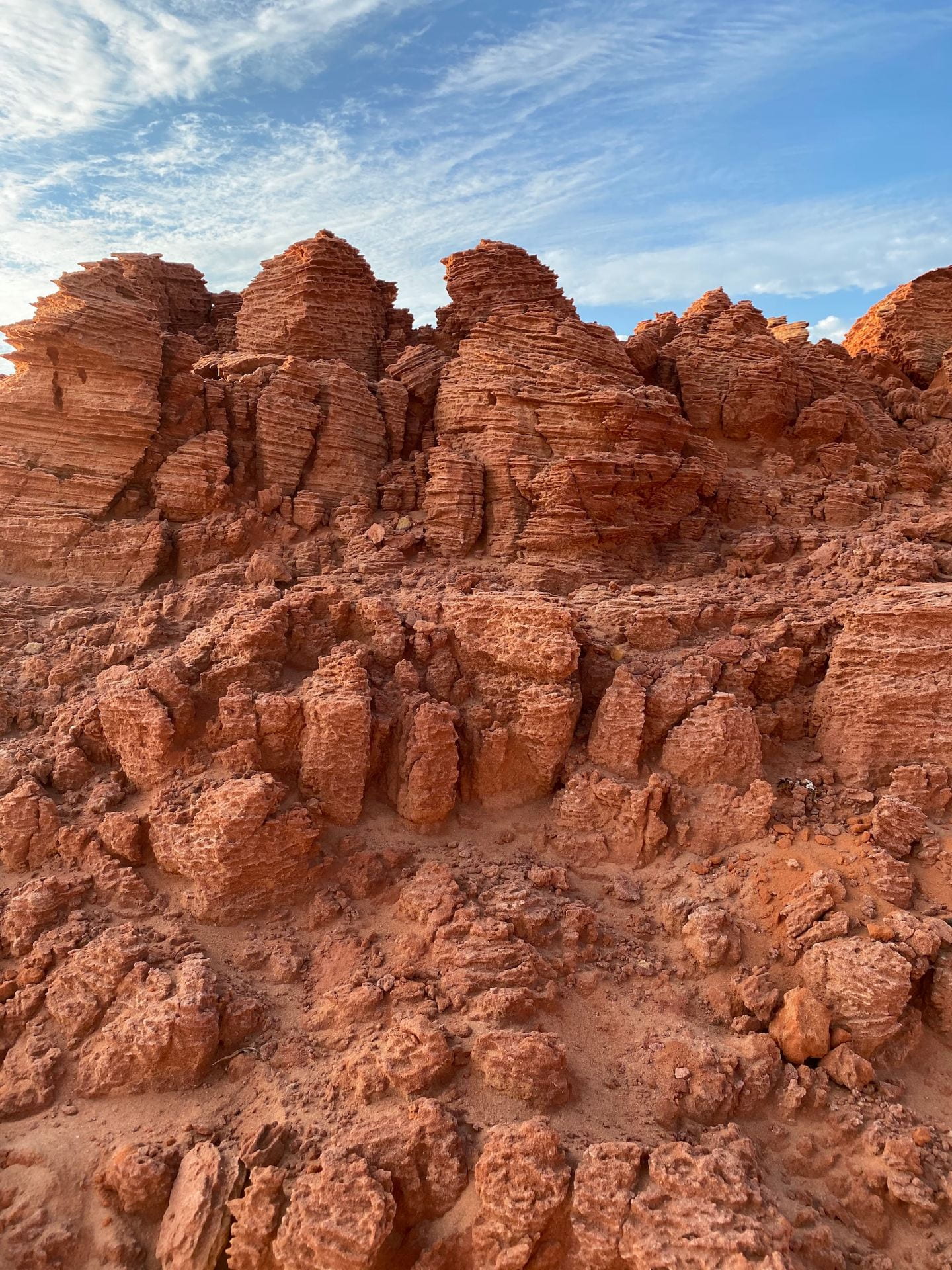
Although the camping facilities were clearly in need of an upgrade, Kooljaman was a lovely place to stay, with a “sunrise beach” for swimming to the east, and the wild, lonely “sunset beach” to the west. The western cliffs were red and rugged: they gave the whole coastal landscape an eerie, other-worldly aspect when we walked to the western beach each day to drink in the sunsets. One traveller commented that the rocks there, considered sacred by the Bardi people, looked rather like the Grand Canyon in miniature.

We thought that we heard barking owls calling to each other in the Kooljaman campground at night. David commented that one sounded like a small yappy dog while the other had a deeper, more sonorous sound.

A vine curls its way between the rocks and sand.

As we drove out of Kooljaman, there were a few tricky moments when we had to pass other cars by pulling off the road into the deep sand piled up on the sides. At one point, I felt sure that we were about to get bogged. Not surprisingly, David retained his composure while I imagined being stuck helplessly on the sandy edge for an indefinite period. By reversing and manoeuvring, we came down off the hill of sand and made our way without further incident back to Broome.

After this week, I am fairly sure that if we were a couple of barking owls, I’d be the yapping, insistent type, while David would bark in a deeper, more soothing fashion.

Final Notes
Accommodation

  • Broome: Tarangau Caravan Park (excellent)
  • Cape Leveque: Kooljaman (a beautiful environment, but some maintenance of the information plaques on the boardwalk, as well as other infrastructure, would be beneficial to the whole enterprise)

The Bardi People and Their Language

  • Kooljaman is actually pronounced “Gooljaman” in the Bardi language.
  • About 1000 people identify as Bardi, but only a few older people can still speak the language. The population has grown in the past 80 years, yet the number of native speakers of the Bardi language has declined, largely because the people were moved from mission to mission between 1940 and 1970; this interfered with first-language acquisition.
  • There were only 5 fluent speakers 9 years ago in 2012, when Claire Bowern published her grammar of the language.

A Very Few Interesting Details about the Bardi Language – from Claire Bowern’s A Grammar of Bardi

♦ The ending -iidi, when added to nouns, creates the meaning “expert”. When a person displays the noun as a major characteristic, this ending can be used to create a noun signifying a person with expertise in that field:

  • joornk – fast joornkiidi – runner
  • goora – game gooriidi – playful person
  • biini – maggot biiniidi – an extremely deviant person

♦ The past tense, as in other Australian languages from the region, is created with the prefix ng- or nga-.

♦ What English-speakers might call the conditional or subjunctive, which is used to create hypotheses, to refer to possible worlds or to express wishes, exists with a range of possible meanings in Bardi, as in these sentences:

  • Look out! The snake might bite you. Anjala! Joorroonim oolarlarri.
  • I would like to eat monkey fish from an earth oven. Gaadiliny ngalarlin laalbooyoon.

♦ There is no fricative in the Bardi language. A fricative is a consonant made through turbulent air flow in a small space, e.g., f, th, h and sh in English.

I would have liked to delve deeper, but the grammar by Claire Bowern is far too expert for me; I needed the book that she has created for learners rather than for grammarians.

David, Dot and I visiting the western beach

Camouflage at Kooljaman
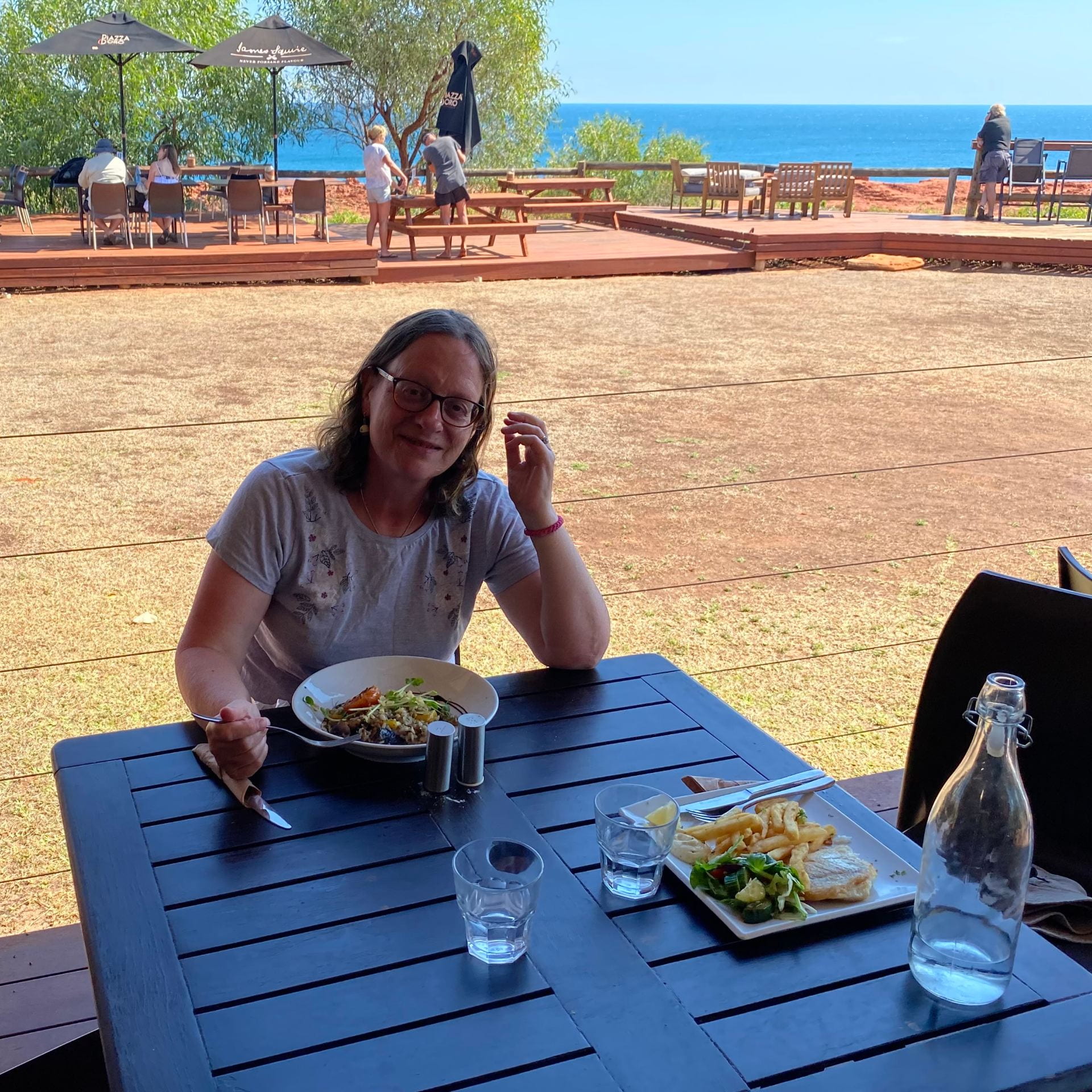
Wild mushroom risotto at the Kooljaman Restaurant
Eating out at the Kooljaman Restaurant

Karijini – Via Paraburdoo and Tom Price

Karijini in sunlight and shadow

We were told by fellow travellers weeks ago that the campgrounds within Karijini were booked solid through May, so we pondered on how best to visit the park regardless. In the end we settled on camping at Tom Price and considered ourselves lucky to be able to book a campsite for three consecutive nights.

Spinifex – like spiky little clouds on the earth

Like Paraburdoo, Tom Price is built around the mining industry: its strength is in function rather than beauty. The housing is flat, simple and inexpensively constructed. Both towns have covered ways for shoppers and specially built shade roofing for parked cars, which is a sensible measure, given the mean maximum temperature in January of over 40 degrees in Paraburdoo and over 38 in Tom Price. Melbourne’s mean maximum, in contrast, is 26, so these two Pilbara towns really swelter in the summer. Paraburdoo reaches around 33 degrees on a standard summer day by 9am. If I lived there, I would melt into the iron-rich ground.

The ground was like iron…

As it turned out, Tom Price was a pleasant though rather crowded campground, populated by tourists like us as well as a school group, road men, miners and other transitory workers. The downside of staying there, apart from needing to break out our screw-in pegs, was having to drive further each day to visit Karijini. The upside was the extra time for knitting on the way.

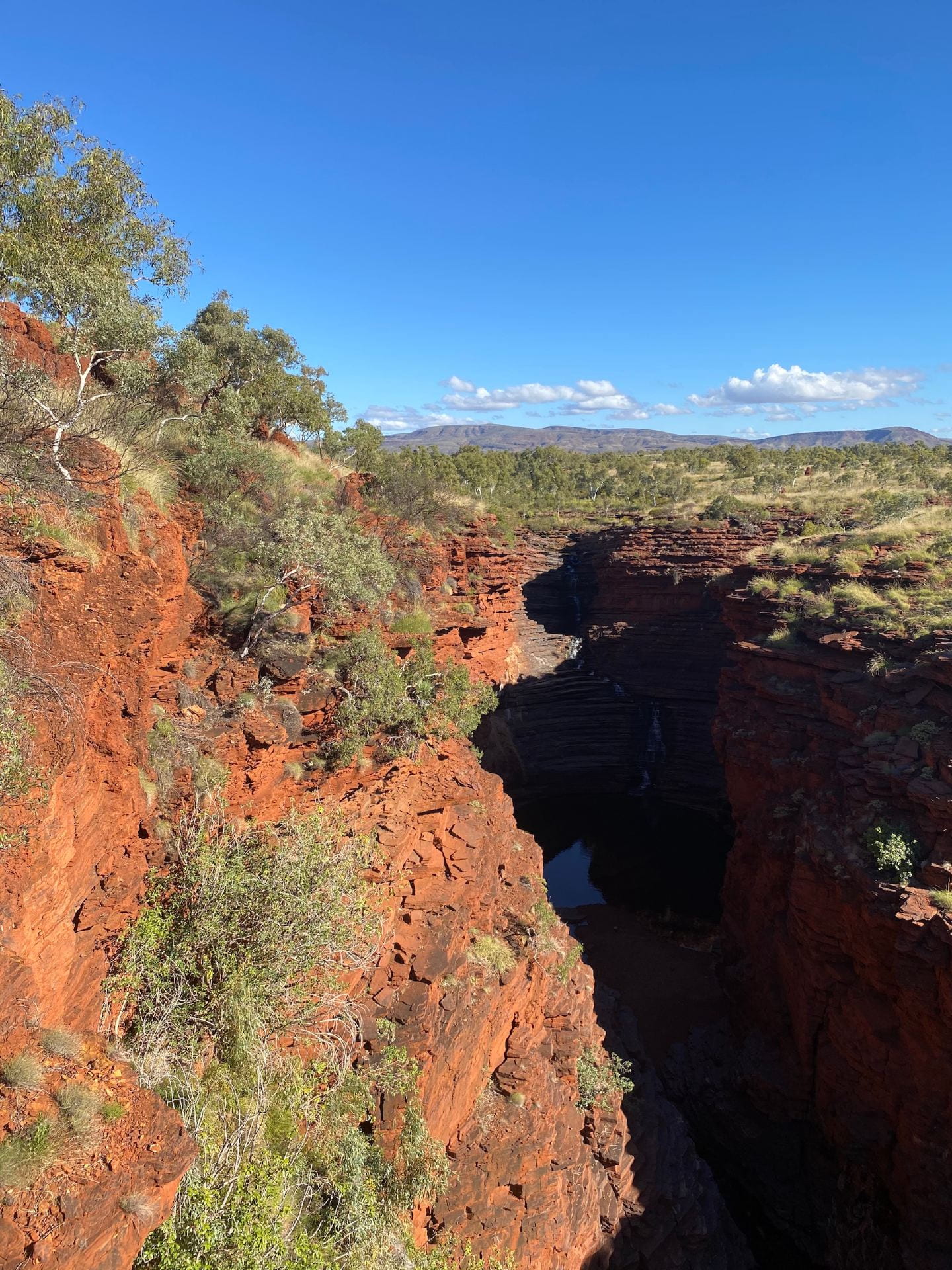
Joffre Gorge – sudden chasms cleaving the earth

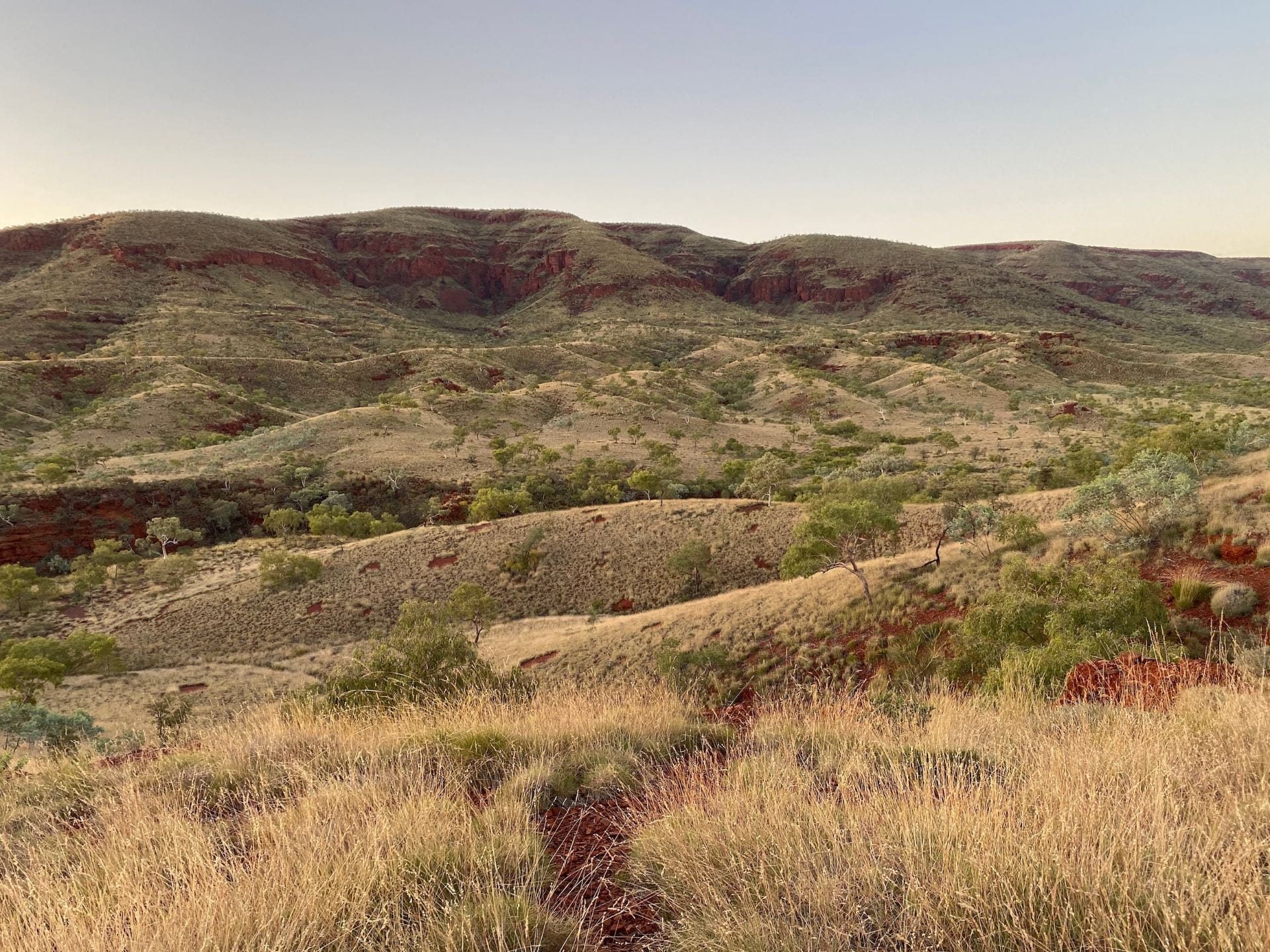
The altitude of Tom Price and the surrounding area took the sting out of the northern sun. We were surrounded by mountains and hills, blue-green in the distance but changing to deep red and green when we drove closer. David marvelled at how suddenly the landscape within Karijini changed from grassy plains to deep chasms, as though a giant hand had cut into the land with a scythe.

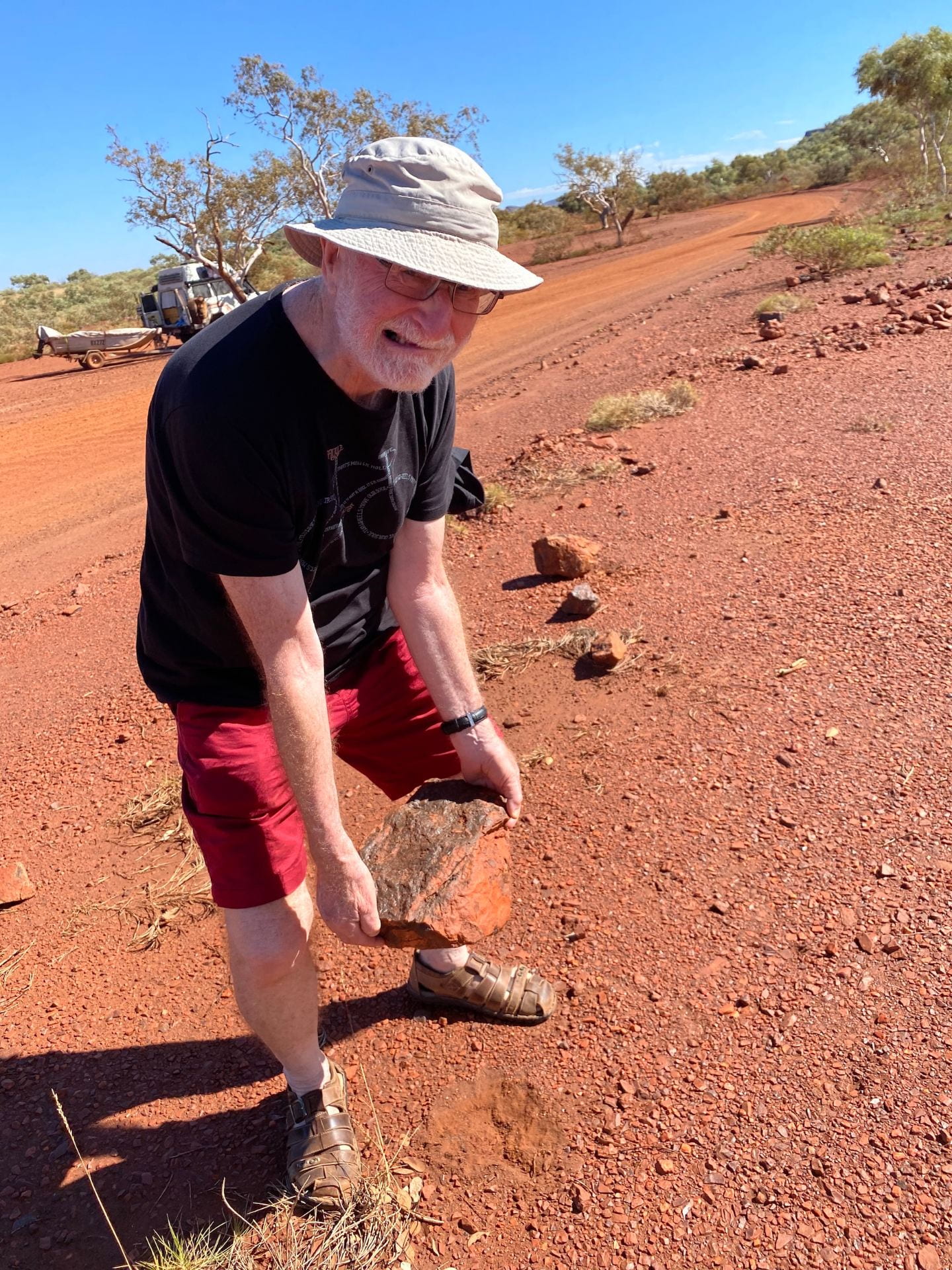
The colours of Karijini are distinctive, especially the deep red of the soil, the soft green of the grass and spinifex, and the iron grey-brown of the stones, which are surprisingly heavy, presumably because of the iron content. As if to offer even more splashes of colour, the wildflowers were in bloom in shades of yellow, red, fuchsia, pale pink and mauve. It was a very textural place: the layers of rock, the fine stones underfoot, the flaking cliffs, the termite mounds, the fluffy grasses, the spiky spinifex, and the smooth white sheen of the gumtree trunks. I began to dream of knitting a rug that might weave together all these rich colours and patterns, but of course no design, however ingenious, could ever reflect the natural cohesion and coherence of that environment.

Grevillea growing along the Dales Gorge

In the town library, a small and friendly place with nearly as many DVDs as books, I discovered in a book by May Byrne, an indigenous leader in the region, that the word “Pilbara”is pronounced “Bilbarda” and means “dry” or “arid” in the Banjima language. The Banjima people, original inhabitants of some parts of the National Park, won a Native Title case in 2014. It made me happy to think that Indigenous people have managed to wrest some of their land back from the mining giants and other interested players.

After we left Tom Price, we decided to stay one more night nearby, at a free camp called Albert Tognolini Rest Area, just northeast of the National Park. This allowed us to take one final farewell walk along the Dales Gorge in the afternoon sunlight, and so extend our brief time at Karijini. All the same, so much remains to be discovered there, as in the whole of Western Australia, that I felt we had barely brushed the surface of the red earth.

♦ ♦ ♦ ♦ ♦ 

The view from the Albert Tognolini Free Camp Rest Area

Final Notes

*Accommodation:

*Paraburdoo‘s name comes from the indigenous word “pirupardu”, meaning “meat feathers”, which refers evidently to the white corellas that live there.

*About the Dales Campground (one of the two accommodation options within Karijini)

We wondered whether the “fully booked” sign was accurate. At least two-thirds of the sites seemed to be vacant. Could there be something wrong with the online booking system? This was hinted at by some user reviews in the Wikicamps app.

*The Name of Mount Nameless: 

Lola Young, a Yinhawangka elder, as reported on a board at the Information Centre in Karijini National Park, commented with some asperity that this mountain always had a name: Jarndunmunha. She said: “They didn’t ask the Aboriginal people here if that place already had a name. And it had.”

*At Pardoo Roadhouse (350 km northeast of Karijini): 
For the first time on this trip, we heard Indigenous people speaking an Aboriginal language together. They may have been Ngarla people, since that is the language group in this area. The Ngarla  people also won a Native Title case back in 2007. 
Dawn at Pardoo Station
On our first day at Karijini, it was a bit too cold to swim, but that didn’t stop the young ones…
Heavy rocks
Hamersley Gorge
Davey living on the edge
A fashion sin of the first order: cow socks with sandals