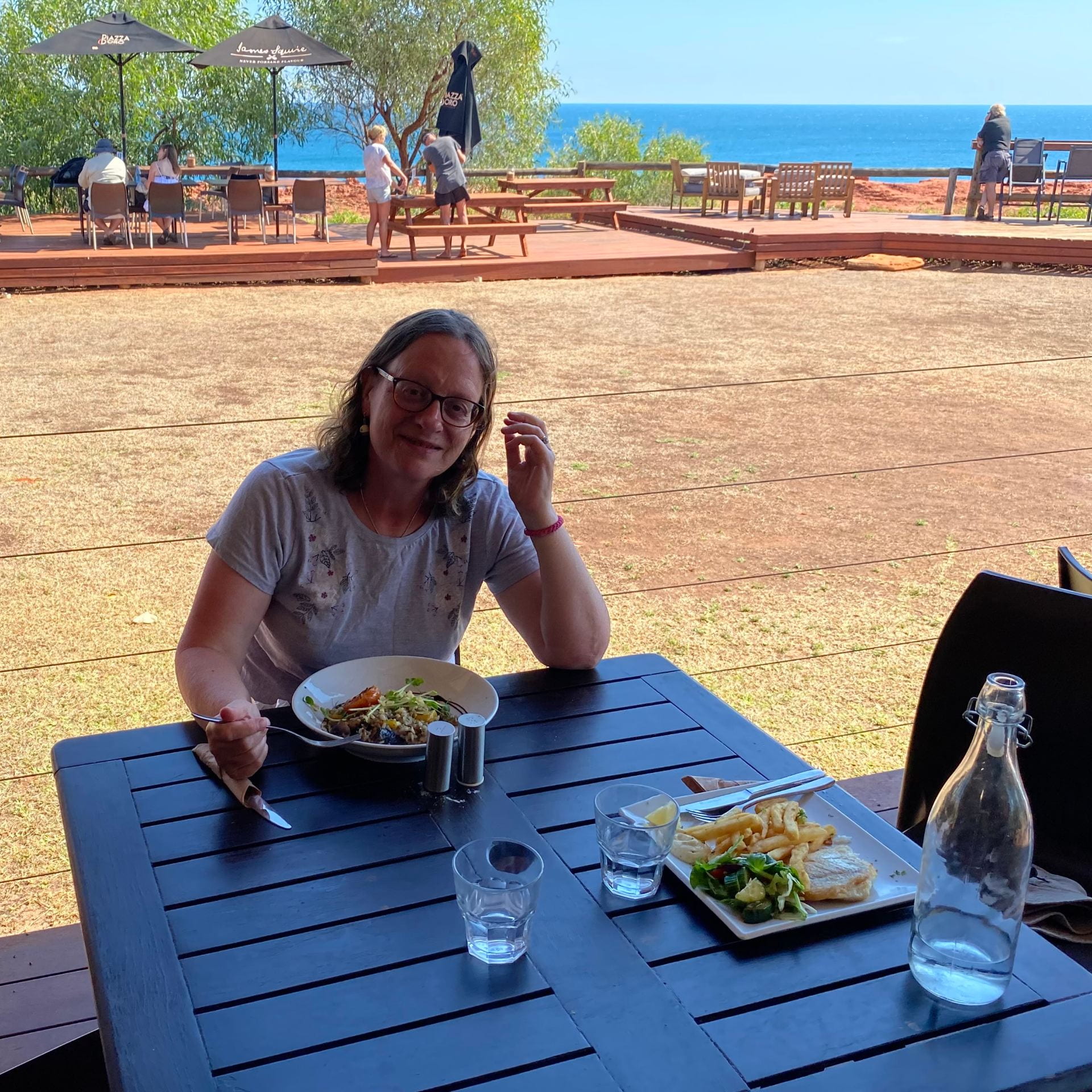
On the way from Broome to our campground at Kooljaman, I felt rather jittery about the roads and the capacity of our “almost 4WD” to deal with them. According to reviews and other literature, the last 10 kilometres of the trip called for a 4WD with high clearance, rather than an AWD with mere standard clearance like ours.
I hadn’t realised that our car was not a “proper 4WD” until I had read a pamphlet a few weeks back about which types of cars would be safe to drive in Francois Peron National Park. Our spanking new Subaru Forrester had been classified in one mean-spirited brochure as a definite non-starter, which had made me doubt its credentials for today’s driving challenge. What if we got bogged in the 10 kilometres of sand that we would have to navigate before reaching our campsite?
As always in such situations, David was nonchalant and unconcerned. “Of course we won’t get bogged,” he said. “This car will manage fine.”
David is always laid-back and optimistic, whereas I invent problems and dread situations that may never arise.
Fortunately the roadworks that pervade the whole of Western Australia had also touched this little northern point of the Dampier Peninsula; the 10 kilometres of unmade roads turned out to be only 3.7 kilometres. There was certainly a lot of sand threatening to ensnare us, but we rolled through it all and only came close to getting bogged when we reached our campsite, where the sand was treacherously deep. Davey managed to reverse out of the quagmire. Once again, his nonchalance was more justified than my nerves.
Later, when my sister Dot arrived, I observed that even in her 4WD she had to be careful when navigating through the sand. As I listened to the interaction between her and her male companion, it occurred to me that David and I are not the only ones who see the world from opposing points of view.

One of the pleasures of travelling with another woman, incidentally, is the opportunity to whinge about male companions. I had missed this experience for 7 long weeks. It seemed a bit churlish, however, to take full advantage of it now, for David calmly continued to do all the things that make him, in the main, an admirable travelling companion: he cooked chicken curry while the rest of us walked past the red cliffs to the western beach to watch the sunset; he produced obscure and desirable items that no one else could find; and he approached every worry with his customary, easy-going serenity.
The relationship between camping couples was particularly easy to discern in this small, tightly packed campground. One afternoon, an array of 4WDs with wild and wonderful camper trailers, some with fold-out hydraulic tents, arrived to take up 3 or 4 spots near ours; we watched the drivers’ attempts to manoeuvre into their narrow sites with a certain fascination. I prefer not to park even a car with others watching; how much harder must it be to back a trailer into a small area while other campers assess your prowess? One woman bawled at her partner, whose trailer had reached less than a 90-degree angle to his car, “All you needed to do was reverse straight!” My heart went out to the hapless driver. (David mentioned later that this V-shape between a car and van is called jackknifing and can lead to axle damage.)

The Kooljaman campground is located on land belonging to the Bardi people. Archaeological excavations indicate that they have inhabited the surrounding islands and this spectacular coastline for at least 27,000 years. The business enterprise itself is owned by the communities of One Arm Point and Djarindjin. A few Bardi people work at the Kooljaman Resort and others live in isolated communities, to which visits are currently banned because of the COVID virus. A very few older people continue to speak the Bardi language, children learn the language in the Djarindjin Lombardina school, and there is a Bardi dictionary, as well as a grammar, published in 2012 by Claire Bowern. The young Bardi woman who works at Kooljaman reception told us that her grandmother still speaks Bardi to her. The language is listed as endangered because so few native speakers now exist: 9 years ago, there were only 5 fluent native speakers remaining.
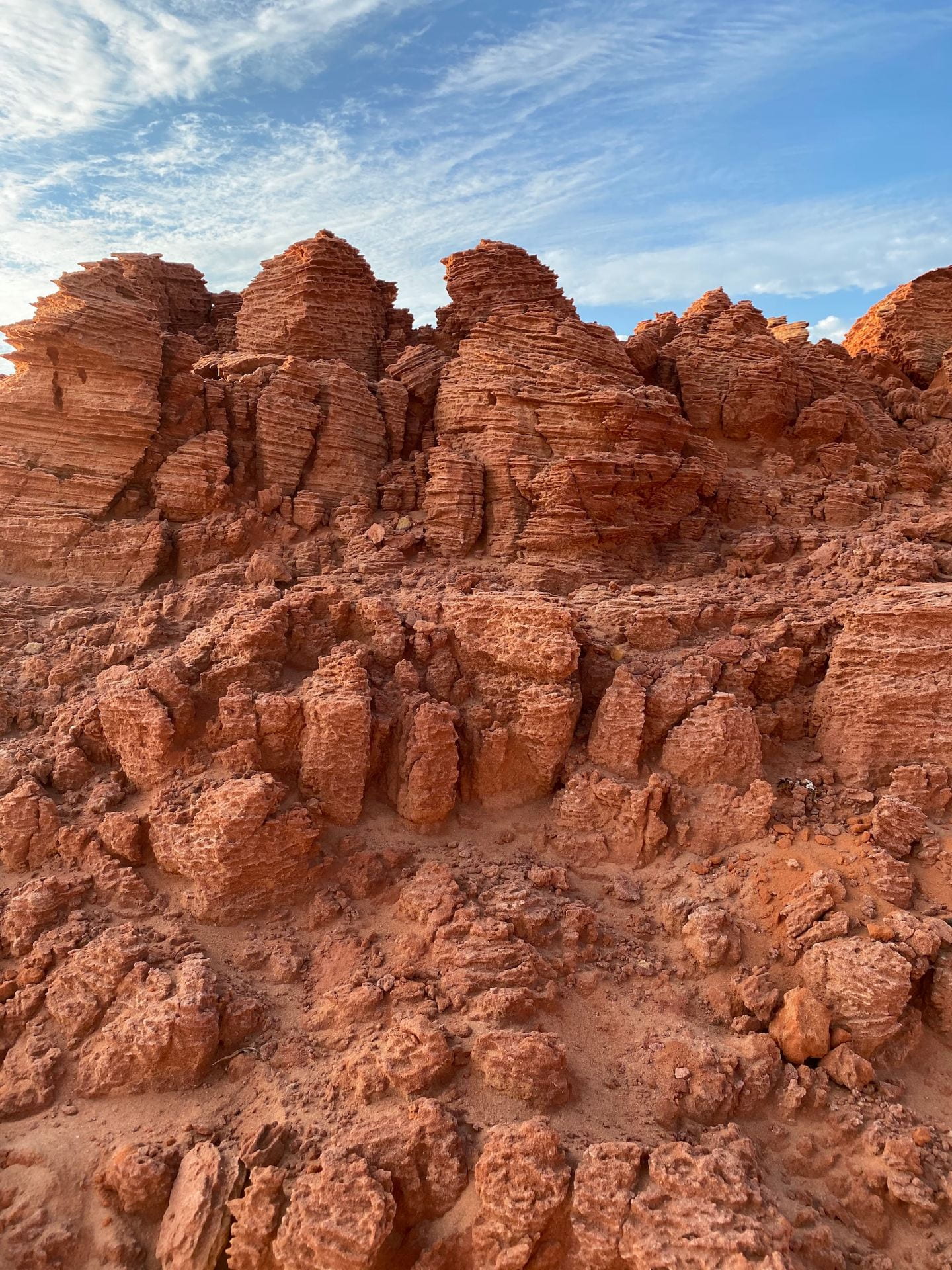
Although the camping facilities were clearly in need of an upgrade, Kooljaman was a lovely place to stay, with a “sunrise beach” for swimming to the east, and the wild, lonely “sunset beach” to the west. The western cliffs were red and rugged: they gave the whole coastal landscape an eerie, other-worldly aspect when we walked to the western beach each day to drink in the sunsets. One traveller commented that the rocks there, considered sacred by the Bardi people, looked rather like the Grand Canyon in miniature.
We thought that we heard barking owls calling to each other in the Kooljaman campground at night. David commented that one sounded like a small yappy dog while the other had a deeper, more sonorous sound.

As we drove out of Kooljaman, there were a few tricky moments when we had to pass other cars by pulling off the road into the deep sand piled up on the sides. At one point, I felt sure that we were about to get bogged. Not surprisingly, David retained his composure while I imagined being stuck helplessly on the sandy edge for an indefinite period. By reversing and manoeuvring, we came down off the hill of sand and made our way without further incident back to Broome.
After this week, I am fairly sure that if we were a couple of barking owls, I’d be the yapping, insistent type, while David would bark in a deeper, more soothing fashion.
Final Notes
Accommodation
- Broome: Tarangau Caravan Park (excellent)
- Cape Leveque: Kooljaman (a beautiful environment, but some maintenance of the information plaques on the boardwalk, as well as other infrastructure, would be beneficial to the whole enterprise)
The Bardi People and Their Language
- Kooljaman is actually pronounced “Gooljaman” in the Bardi language.
- About 1000 people identify as Bardi, but only a few older people can still speak the language. The population has grown in the past 80 years, yet the number of native speakers of the Bardi language has declined, largely because the people were moved from mission to mission between 1940 and 1970; this interfered with first-language acquisition.
- There were only 5 fluent speakers 9 years ago in 2012, when Claire Bowern published her grammar of the language.
A Very Few Interesting Details about the Bardi Language – from Claire Bowern’s A Grammar of Bardi
♦ The ending -iidi, when added to nouns, creates the meaning “expert”. When a person displays the noun as a major characteristic, this ending can be used to create a noun signifying a person with expertise in that field:
- joornk – fast → joornkiidi – runner
- goora – game → gooriidi – playful person
- biini – maggot → biiniidi – an extremely deviant person
♦ The past tense, as in other Australian languages from the region, is created with the prefix ng- or nga-.
♦ What English-speakers might call the conditional or subjunctive, which is used to create hypotheses, to refer to possible worlds or to express wishes, exists with a range of possible meanings in Bardi, as in these sentences:
- Look out! The snake might bite you. Anjala! Joorroonim oolarlarri.
- I would like to eat monkey fish from an earth oven. Gaadiliny ngalarlin laalbooyoon.
♦ There is no fricative in the Bardi language. A fricative is a consonant made through turbulent air flow in a small space, e.g., f, th, h and sh in English.
I would have liked to delve deeper, but the grammar by Claire Bowern is far too expert for me; I needed the book that she has created for learners rather than for grammarians.
 David, Dot and I visiting the western beach